
Mintlify Promo Code: 6 months free Startup
Beautiful API documentation, auto-generated from code with MDX, interactive examples, and analytics.
Free · Opens in new tab
Already have an account? Log in
Deal Highlights
What Mintlify Gives a Startup
Mintlify builds beautiful API documentation, auto-generated from code with MDX, interactive examples, and analytics, and this deal gives an API-first startup 6 months free on the Startup plan. For a company whose product is an API, documentation is not a nice-to-have, it is part of the product. Developers cannot adopt what they cannot understand, and the quality of the docs often decides whether an evaluation ends in integration or in a closed tab. Mintlify lets a small team ship docs that look and feel like they came from a much larger company, and the six free months cover exactly the window when a young API is fighting hardest for adoption.
The core promise is that great documentation should not require a dedicated docs team or a hand-built site. Mintlify handles the design, the interactivity, and the hosting, and it keeps the reference in sync with the code, so engineers write content in familiar formats and get a polished, fast, searchable docs site without maintaining one. For an API-first startup, that removes one of the most common reasons docs fall behind: they were simply too much work to keep good.
This article covers what Mintlify does, why documentation quality is a growth lever for an API business, how it compares to the alternatives, and how to make the six free months on the Startup plan build a lasting foundation.
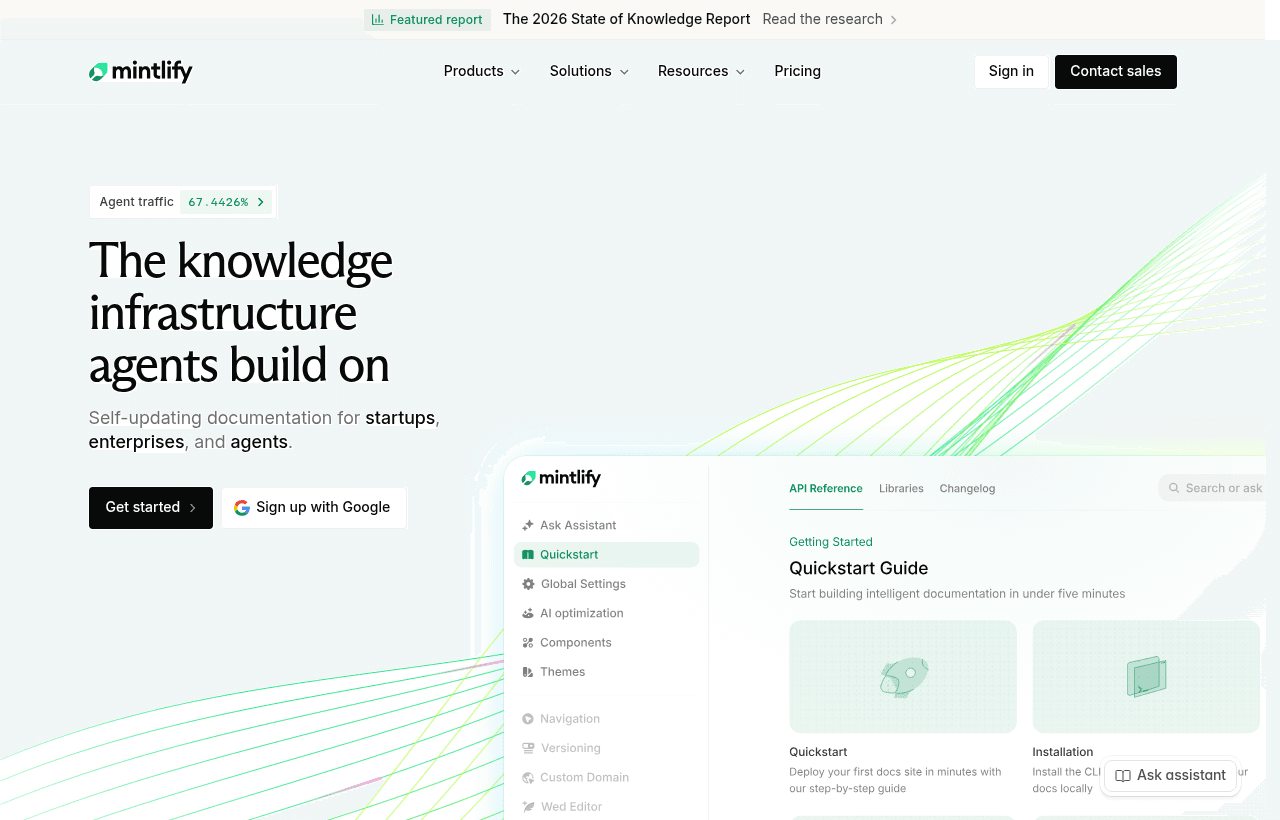
Mintlify, one of the tools included in this startup deal.
Docs That Look Like a Serious Product
First impressions carry weight in developer tools, and the docs are usually the first thing a prospective user sees. Mintlify produces documentation that is clean, fast, and professional out of the box. The typography, navigation, search, and layout are handled for you, so even a two-person startup can present docs that stand next to those of established platforms. You do not design a site or fight with a static-site generator; you write content and Mintlify makes it look right.
For an API-first startup, that polish is not vanity, it is credibility. A developer deciding whether to build on your API is implicitly judging how seriously you take your product, and sloppy or ugly docs send the wrong signal. Beautiful, well-organized documentation says the team cares about the developer experience, which is exactly the reassurance someone needs before committing their own product's reliability to your API. Mintlify lets a small company buy that credibility with effort measured in hours, not the weeks a custom docs site would take.
Because the design is handled, the team's time goes into the content itself, the explanations, the examples, the guides, which is where the real value lives. You are not spending engineering hours on CSS or navigation logic. That reallocation matters most for a startup, where every engineer-hour is scarce and better spent on the product than on a documentation site's plumbing.
Auto-Generated From Code, So Docs Stay Accurate
One of Mintlify's most valuable traits for an engineering team is that reference documentation can be auto-generated from the code and API definition. Instead of maintaining a separate, hand-written list of endpoints that drifts out of date the moment someone ships a change, the reference is derived from the source of truth. When the API changes, the docs can follow.
This solves the oldest problem in documentation: rot. Docs that are written by hand and updated manually always fall behind, because updating them is a separate chore that busy engineers skip under deadline pressure. Outdated docs are worse than no docs, because they actively mislead developers and generate support tickets when the promised behavior does not match reality. By generating the reference from the code, Mintlify keeps the most error-prone part of the docs honest with far less manual effort.
For an API-first startup shipping frequently, this is a real advantage. Early products iterate fast, endpoints change, and a manually maintained doc set simply cannot keep up. Auto-generation means the team can move quickly and still have accurate reference material, which protects both the developer experience and the support inbox. Fewer wrong docs means fewer confused users and fewer tickets, which is time the small team gets back.
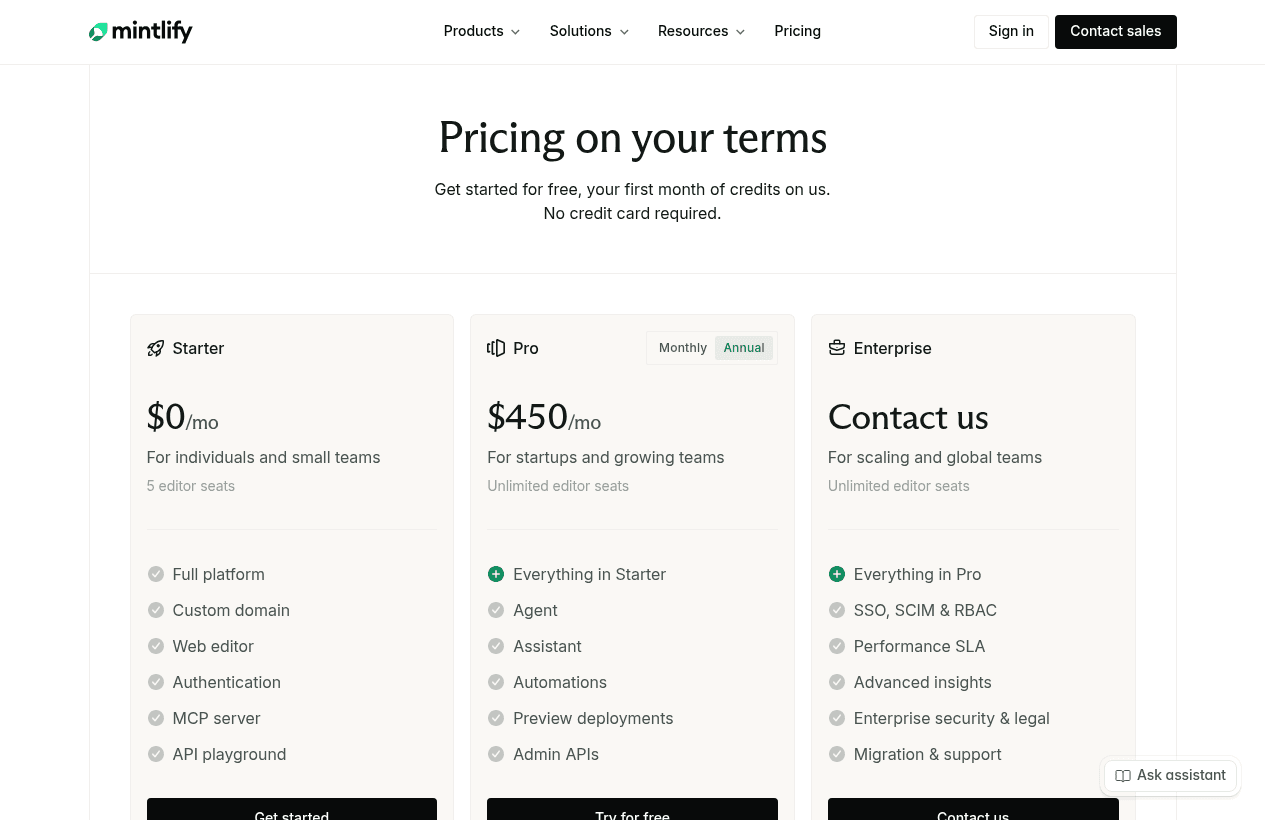
A look at Mintlify before the discount, so you can see what the deal saves you.
Write in MDX With Interactive Examples
Mintlify uses MDX, which lets writers combine standard Markdown with interactive components. That means docs are not static walls of text. You can embed live code samples, interactive API examples that developers can run and tweak, callouts, tabs, and other components that make complex material easier to absorb. The reader does not just read about an endpoint, they can see it work.
Interactivity matters because developers learn by doing. A code sample they can run, edit, and see respond teaches faster than paragraphs of prose. When someone evaluating your API can try a call right there in the docs and get a real response, the distance between reading and integrating shrinks. That shortened path from curiosity to first successful call is often what turns a browser into an adopter. For an API-first startup, reducing time-to-first-call is one of the highest-leverage things you can do, and interactive docs push directly on it.
MDX also keeps the writing experience close to what engineers already know. Markdown is familiar, and the added components are approachable, so the whole team can contribute to docs rather than routing everything through one person. When any engineer can improve the docs for the feature they just built, coverage stays broad and current. That distributed authorship is exactly what a small team needs, since no one has spare time to be the sole docs owner.
Analytics That Show What Developers Struggle With
Mintlify includes analytics, and for a documentation site that is more useful than it first sounds. You can see which pages developers visit, what they search for, and where they get stuck. That turns your docs from a static artifact into a feedback channel about how people actually try to use your product.
For a startup, this insight is gold. If everyone is searching for a term you do not have a page for, that is a content gap you can fill today. If a particular endpoint's page gets heavy traffic and lots of confused searching around it, that endpoint may be genuinely hard to use and worth simplifying in the product itself. Docs analytics quietly tell you where the developer experience is failing, and fixing those spots reduces support load and improves conversion from trial to integration.
This closes a loop that most early teams fly blind on. Without analytics, you find out about doc problems only when someone complains, which is a small and biased sample. With them, you can see the friction that the silent majority hit and never mention before giving up. For an API-first company whose growth depends on developers succeeding on their own, that visibility is a direct input to product decisions, not just a docs nicety.
Mintlify Compared to the Alternatives
The common alternatives are a hand-built docs site on a static-site generator, a generic wiki or knowledge base, or a heavier documentation platform. Each has real drawbacks for an API-first startup.
Building your own docs site with a static-site generator gives full control but costs engineering time both upfront and forever. You design it, host it, wire up search, and maintain the build, and every hour spent on that is an hour not spent on the product. Mintlify gives you a polished, hosted, searchable site without that ongoing burden, which for a small team is usually the better trade.
A generic wiki or knowledge-base tool is fine for internal notes but wrong for developer-facing API docs. It lacks the interactive code examples, the auto-generated reference, and the design polish that developers expect, and it signals that the company did not invest in the developer experience. For an API-first startup, that signal alone can cost adoptions.
Heavier enterprise documentation platforms exist and can be powerful, but they bring cost and complexity that a young startup does not need. Mintlify is aimed squarely at modern API companies and covers exactly what they require, beautiful docs, interactive examples, code-generated reference, and analytics, without the enterprise overhead. Paired with six months free on the Startup plan, it is well matched to a team that needs great docs now and wants to spend its money and time elsewhere.
Making the 6 Months Free Count
Six free months on the Startup plan is a generous runway, and it lines up with the period when good docs matter most: the early push for adoption. To get lasting value, use the time to build a foundation rather than a placeholder.
Start by moving your reference to auto-generation from the code or API definition. That is the change that keeps docs accurate as you ship, and getting it wired up early means every future release stays documented without extra effort. It is the highest-leverage setup step, so do it first.
Invest in the guides, not just the reference. A raw endpoint list tells developers what exists; guides and quickstarts tell them how to actually accomplish something. Use the free months to write a strong getting-started flow and a few task-oriented tutorials, because those are what turn an interested developer into an integrated one.
Add interactive examples to the endpoints people use most. Let developers run a real call from the docs early in their journey. Shortening the path to a first successful request is one of the best returns you can get, so prioritize the examples on your most important endpoints.
Watch the analytics from the start. Once traffic arrives, let the searches and page views tell you where to write next. Filling the gaps developers actually hit is more valuable than guessing, and six months is enough time to run several rounds of that improvement loop.
How Good Docs Drive Growth for an API Business
For most software, documentation is a support cost. For an API-first startup, it is a growth engine, and that distinction is worth internalizing. Your users are developers, and developers evaluate and adopt largely on their own, guided by your docs rather than by a sales call. Good docs let a prospect self-serve from first curiosity to production integration without ever needing to talk to you, which means your documentation is effectively doing the selling.
That self-serve path scales in a way that human touch cannot. A great docs site can convert a thousand developers as easily as ten, at no extra cost per developer, which is exactly the leverage a small team needs to grow without a large support or sales organization. Every improvement to the docs raises the conversion rate of that funnel across every future visitor. Mintlify's combination of polish, accuracy, interactivity, and analytics is aimed precisely at making that funnel work.
There is also a compounding trust effect. As your docs get more complete and more accurate, developers recommend your API to peers, cite it in their own projects, and rely on it with confidence. Reputation in developer communities travels fast, and it is built substantially on documentation quality. Investing in docs early, during the free months, plants that reputation while the company is still small enough for it to matter enormously.
Who Should Claim This Deal
This deal is built for exactly the company the requirement names: an API-first startup. If your product is an API, or if an API is a central part of how customers use your product, then documentation is core to your success and Mintlify is a strong fit. The six months free on the Startup plan covers the critical early window when you are working to win over the first wave of developers, and doing it with polished, accurate, interactive docs gives you an edge that many competitors neglect.
It suits teams that are shipping fast and cannot afford to maintain docs by hand, since auto-generation keeps the reference honest through frequent changes. It suits small teams without a dedicated docs writer, because MDX lets every engineer contribute and Mintlify handles the design and hosting. And it suits any founder who understands that for a developer product, the docs are part of the funnel, not an afterthought.
The teams that will get less from this are those whose product is not developer-facing and has no API to document, where a general knowledge base would serve just as well. But for an API-first startup, claiming six free months of Mintlify is a direct investment in the thing that most determines whether developers adopt your product. It lets a small team present world-class documentation from day one, keep it accurate as they grow, and learn from real usage where to improve, all during the exact period when getting docs right matters most.
Who Is This Deal For?
Early-Stage Startups
Seed and pre-seed companies looking to move fast without overspending on tools.
Growing SaaS Teams
Series A+ companies scaling their stack and optimizing software costs.
Solo Founders
Indie hackers and bootstrapped founders who need enterprise tools at startup prices.
Get 6 months free Startup off Mintlify
Premium deal. Upgrade once, unlock everything.
!Eligibility Requirements
API-first startup
Frequently Asked Questions
Everything you need to know about this startup deal.
Mintlify focuses specifically on developer-facing API documentation with better design defaults and API playground. GitBook is more general-purpose technical documentation. Choose Mintlify for API docs; GitBook for broader technical docs.
Get the weekly deals digest
New verified startup deals every week. No spam, ever. Unsubscribe anytime.
Related Offers

Toggl Track
Used by 1,100 members
Free Plan
Simple and intuitive time tracking for teams with reporting and integrations.
View offer
Auth0
Used by 994 members
1 year of B2B Professional free
Get 1 year of the Auth0 B2B Professional plan free, with up to 100,000 monthly active users, SSO, enterprise MFA and SCIM.
View offer
Bugsnag
Used by 471 members
Free Plan
Error monitoring and stability management for web and mobile applications.
View offer
Turborepo
Used by 1,880 members
Free & Open Source
High-performance build system for JavaScript and TypeScript monorepos by Vercel.
View offer
Windmill
Used by 1,501 members
Free Plan
Open-source developer platform for building internal tools, workflows, and scripts.
View offer
Height
Used by 1,442 members
Free Plan
AI-powered project management tool with autonomous task management and workflows.
View offerDeal Summary
Looking for more startup deals?
Browse all offers