
Postman Promo Code: 1 year free Basic team
Design, test, and document APIs with the platform used by 30 million developers worldwide, free for startup teams.
Premium: $79/year for unlimited deals
Already have an account? Log in
Deal Highlights
What Postman Gives a Startup
Postman is the platform teams use to design, test, and document APIs, and it is used by tens of millions of developers around the world. This deal gives a startup engineering team a full year free on the Basic team plan. For a company building software today, where almost everything talks to something else over an API, that is a year of professional-grade tooling for the layer that ties the whole product together, at no cost.
The offer targets exactly the moment where it matters most. Early on, a startup's APIs are changing constantly. New endpoints appear, old ones get reshaped, and the contract between the backend and everything that consumes it is in motion every week. Postman gives the team a shared place to see that contract, exercise it, and keep it documented while it moves. A free year covers the stretch when the product is finding its shape, which is exactly when good API tooling saves the most time.
The core value is that Postman replaces a scattered pile of half-remembered curl commands, private scripts, and tribal knowledge with one system the whole team shares. Everyone works from the same collection of requests, sees the same environments, and reads the same documentation. The API stops being something only its author understands and becomes something the team owns together.
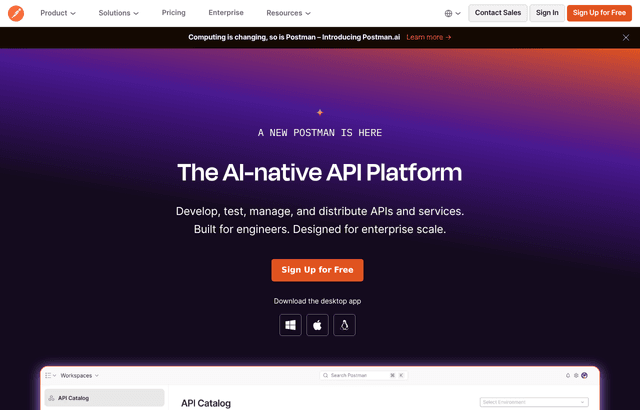
Postman, one of the tools included in this startup deal.
A Shared Home for the API
The first thing Postman changes is where API knowledge lives. Without it, that knowledge is spread across individual laptops. One engineer has a working request saved locally. Another has a slightly different version. A third is reconstructing the same call from memory because they never got the first two. The team is testing the same endpoints over and over, separately, and none of the work is shared.
Postman collects requests into collections that the whole team can open, run, and edit. When someone builds a working call against an endpoint, they save it once and everyone has it. When the endpoint changes, the collection updates and everyone sees the new shape. The result is that the effort of understanding the API is spent once and reused, instead of paid repeatedly by every person who touches it.
For a startup, that compounding matters. Small teams cannot afford to have three people independently rediscover how the same endpoint works. Postman turns that redundant effort into shared assets, which frees people to build instead of re-deriving what a teammate already figured out last week.
Testing the API Before Customers Do
Building an endpoint is only half the job. The other half is making sure it behaves the way it is supposed to, and keeps behaving that way as the code changes around it. Postman is built for exactly this. A team can send requests with any method, headers, and body, inspect the full response, and confirm the endpoint returns what it should before shipping anything that depends on it.
It goes beyond manual checks. Postman lets a team write tests that run against responses automatically, asserting that the status is right, that the fields are present, and that the values make sense. Those tests can run across a whole collection at once, so the team can verify a large surface of the API in one pass. When something breaks, the team finds out from a failing test rather than from a customer.
For a startup, this is the difference between shipping with confidence and shipping with crossed fingers. The pace of early development means endpoints change fast and regressions are easy to introduce. Automated API tests catch those regressions early, when they are cheap to fix, instead of after they have reached production and someone is filing a bug report.

A look at Postman before the discount, so you can see what the deal saves you.
Environments That Keep Development Sane
Real teams run their API in more than one place. There is a local version on each developer's machine, a staging version for testing, and a production version serving customers. The requests are the same, but the addresses, keys, and secrets differ. Managing that by hand, editing URLs and tokens every time you switch, is tedious and error-prone. The classic mistake is running a test meant for staging against production.
Postman handles this with environments. A team defines each environment once, with its own variables for base URLs, keys, and tokens, and then switches between them with a single selection. The same request runs against local, staging, or production depending on which environment is active, with no manual editing. The dangerous mistake of pointing the wrong request at the wrong system gets much harder to make.
This structure keeps a growing team coordinated. New engineers inherit the environment setup instead of building their own from scratch and getting it subtly wrong. The whole team shares one definition of what staging and production are, which removes a whole class of confusing, hard-to-reproduce problems that come from everyone using slightly different configurations.
Documentation the Team Actually Keeps
API documentation is famously the thing every team means to write and never does. It lives in someone's head, in an outdated wiki page, or nowhere at all. That gap hurts most when a new hire joins, when a frontend developer needs to consume a backend endpoint, or when a partner wants to integrate. Everyone loses time asking questions that documentation should have answered.
Postman generates documentation directly from the collections the team already builds. Because the requests are already defined, with their parameters and example responses, the documentation is a natural extension of the daily work rather than a separate chore. It stays close to the real API because it comes from the same source the team is using to test that API. When the collection updates, the documentation reflects it.
For a startup, this closes the gap between building an API and making it usable by others. A frontend developer can read exactly how to call an endpoint. A new backend hire can explore the whole API without interviewing a teammate. If the company exposes an API to customers or partners, Postman gives it a credible starting point for external documentation without a separate documentation project.
Collaboration Built for a Growing Team
The Basic team plan is a team plan, and that is the point. Postman is designed for people to work together on the same API. Collections, environments, and documentation live in a shared workspace where the whole team has access. When one person improves a request or adds a test, everyone benefits without a handoff.
This collaboration model fits how a startup actually grows. The first engineer builds the API. The second joins and inherits everything already in the workspace. The frontend developer consumes endpoints straight from the shared collections. Each new person plugs into a system that already holds the team's collective knowledge, instead of starting from a blank slate and rebuilding what already exists.
Shared workspaces also reduce the fragility that comes from key people. When one engineer holds all the API knowledge in their own local setup, the team is exposed if that person is out or leaves. Postman moves that knowledge into a shared, durable place. The API stays understandable and workable regardless of who is available on any given day.
Postman Compared to curl Scripts and Homegrown Tools
A startup that has not adopted Postman is usually getting by with some combination of curl commands, small custom scripts, and browser tools. Each of these can send a request, and for a single developer testing a single endpoint, they are fine. The problem is that none of them scale to a team or to a real product.
Curl commands are private and disposable. They live in shell history and personal notes, they are not shared, and they carry no documentation or tests. Custom scripts are better but become their own maintenance burden, a small internal tool nobody owns that quietly rots. Neither approach gives the team shared collections, managed environments, automated tests, or generated documentation. They solve the narrow act of sending one request while leaving the actual work of running an API as a team completely unaddressed.
Postman replaces all of it with one coherent platform. The requests are shared instead of private. The environments are managed instead of hand-edited. The tests run automatically instead of by memory. The documentation comes for free instead of never getting written. For a startup, consolidating on one tool that the whole industry already uses also means new hires arrive already knowing it, which removes even the cost of learning something bespoke.
Making the Free Year Count
A year free on the Basic team plan is generous, and a startup gets the most from it by moving its API work into Postman fully rather than treating it as an occasional utility. The teams that benefit most set up their workspace early and make it the default place API work happens.
Start by building collections for the endpoints the team already has, so the existing API is captured in one shared place. Define environments for local, staging, and production up front, so switching between them is safe from the beginning. As new endpoints get built, add them to the collections as a matter of habit, so the shared picture of the API stays current instead of drifting out of date.
Once the collections exist, add tests to the endpoints that matter most, so regressions get caught automatically as the code changes. Then lean on the generated documentation whenever a new person joins or a new consumer needs to integrate. Each of these steps takes little time on its own, and together they turn Postman from a request tool into the backbone of how the team handles its API.
Because the plan is free for a full year, there is no reason to ration usage or hold back. The team can put its entire API into Postman, give everyone access, and use every part of the platform. That full adoption is exactly what makes the free year pay off, because the value comes from the whole team working in one shared system rather than from any single feature.
How Postman Scales As You Grow
The worry with adopting any tool early is whether it still fits later. Postman scales along the exact dimensions a startup grows on. As the API surface expands, collections keep it organized rather than letting it sprawl. As the team grows, the shared workspace absorbs new people without friction. As the product matures and gains external consumers, the documentation and testing capabilities are already in place to support them.
There is also a clear continuation once the free year ends and the company keeps growing. Postman offers larger plans with more capacity and more advanced capabilities, and moving up does not mean leaving the tool or migrating the team's accumulated collections, environments, and tests. The work done during the free year carries forward. A startup can commit to Postman now, knowing it will not have to rip it out and start over the moment the company gets bigger.
That continuity is a real part of the value. Tooling that only fits one stage forces a disruptive switch at the worst possible time. Postman is the same platform for a two-person team and for a large engineering organization, which means the habits and assets a startup builds during its free year stay useful for years afterward.
Who Should Claim This Deal
This deal is for any startup engineering team that builds or consumes APIs, which today is very nearly all of them. The requirement is simply that you are a startup engineering team, and the reward is a full year of the Basic team plan free.
It is an especially strong fit for a team that is currently getting by on scattered curl commands and private scripts and feeling the pain of it, because Postman replaces that mess with one shared system. It fits teams that are hiring, since new engineers plug straight into a workspace that already holds the team's API knowledge. And it fits any company whose product exposes an API to customers or partners, because Postman covers designing, testing, and documenting that API in one place.
A startup that has lost time to an endpoint nobody documented, a regression that reached production, or a test accidentally run against the wrong environment will feel Postman's value quickly. The tool is the industry standard, the whole team can share it, and the offer covers a full year at no cost during the exact period when the API is changing fastest. For a team that wants to treat its API as the serious asset it is, this deal is worth claiming today.
Who Is This Deal For?
Early-Stage Startups
Seed and pre-seed companies looking to move fast without overspending on tools.
Growing SaaS Teams
Series A+ companies scaling their stack and optimizing software costs.
Solo Founders
Indie hackers and bootstrapped founders who need enterprise tools at startup prices.
Get 1 year free Basic team off Postman
Premium deal. Upgrade once, unlock everything.
!Eligibility Requirements
Startup engineering team
Frequently Asked Questions
Everything you need to know about this startup deal.
Postman has a free plan for individual use. The Basic team plan ($14/user/month) adds collaboration, shared workspaces, and team roles. The 1-year deal saves $168/user.
Get the weekly deals digest
New verified startup deals every week. No spam, ever. Unsubscribe anytime.
Related Offers

Toggl Track
Used by 1,100 members
Free Plan
Simple and intuitive time tracking for teams with reporting and integrations.
View offer
Auth0
Used by 994 members
1 year of B2B Professional free
Get 1 year of the Auth0 B2B Professional plan free, with up to 100,000 monthly active users, SSO, enterprise MFA and SCIM.
View offer
Bugsnag
Used by 471 members
Free Plan
Error monitoring and stability management for web and mobile applications.
View offer
Turborepo
Used by 1,880 members
Free & Open Source
High-performance build system for JavaScript and TypeScript monorepos by Vercel.
View offer
Windmill
Used by 1,501 members
Free Plan
Open-source developer platform for building internal tools, workflows, and scripts.
View offer
Height
Used by 1,442 members
Free Plan
AI-powered project management tool with autonomous task management and workflows.
View offerDeal Summary
Looking for more startup deals?
Browse all offers