
Pusher Startup Credits: $500 in credits
Realtime APIs for web and mobile, channels, presence, and triggers for live notifications and updates.
Premium: $79/year for unlimited deals
Already have an account? Log in
Deal Highlights
Adding a live feature to an app, a notification that appears without a refresh, a counter that updates as things happen, a status that changes in real time, sounds simple and turns into a websocket infrastructure problem. Pusher exists to skip that: it provides hosted real-time messaging through an API, so you publish an event on your backend and it appears instantly in every connected client, without you running websocket servers or solving the scaling that comes with them.
Whether you need a hosted real-time service over building it yourself is the real question, and this covers what Pusher does, how it prices, and where it fits.
What Is Pusher?
Pusher is a hosted real-time messaging platform. Its core product, Channels, is a publish-subscribe system: clients subscribe to named channels, your backend publishes events to those channels, and Pusher delivers each event to every subscribed client in real time over a persistent connection it manages.
The model is deliberately simple. A channel is just a named stream. Public channels are open, private channels require authorization so only permitted clients can subscribe, and presence channels additionally track who is currently subscribed, which is how you build "who is online" and live-collaboration features. Your backend triggers events; connected clients receive them through Pusher's SDKs for web and mobile.
That simplicity is the point. Pusher handles the persistent connections, the reconnection logic, the scaling to many concurrent clients, and the delivery, leaving you to publish events and react to them. For common real-time needs, notifications, live updates, activity feeds, simple collaboration, it removes an entire category of infrastructure.
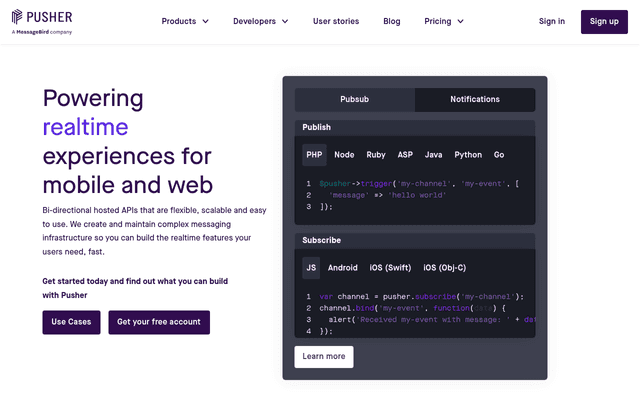
Pusher, one of the tools included in this startup deal.
What's Included in This Deal
- Channels for real-time publish-subscribe messaging
- Private and presence channels for authorized and who-is-online features
- Client SDKs for web and mobile frameworks
- Managed connections and scaling handled for you
- Credits or a free tier to build and test
The credits let you build a real live feature and test it under realistic connection counts before committing, which is the right test, because whether hosted real-time is worth its cost depends on your concurrency and how much building the equivalent would take.
Pusher Pricing: Connections and Messages
Pusher prices on concurrent connections and messages, the two dimensions that define real-time load, with a free tier for small applications.
| Consideration | Detail |
|---|---|
| Free tier | A limited number of concurrent connections and daily messages |
| Paid plans | Scale with concurrent connections and message volume |
| Enterprise | Custom, for high scale |
The two numbers to model are peak concurrent connections, how many clients are connected at once at your busiest, and message volume, how many events flow through. These are different from total users: a product with a hundred thousand users but only a few thousand connected simultaneously is priced on the few thousand. Estimate the concurrent peak rather than the user count, because that is what the bill tracks, and a feature where every user holds a live connection all day scales differently from one where connections are brief.
The honest way to weigh the cost is against building and operating the equivalent yourself, which is the decision that actually matters.
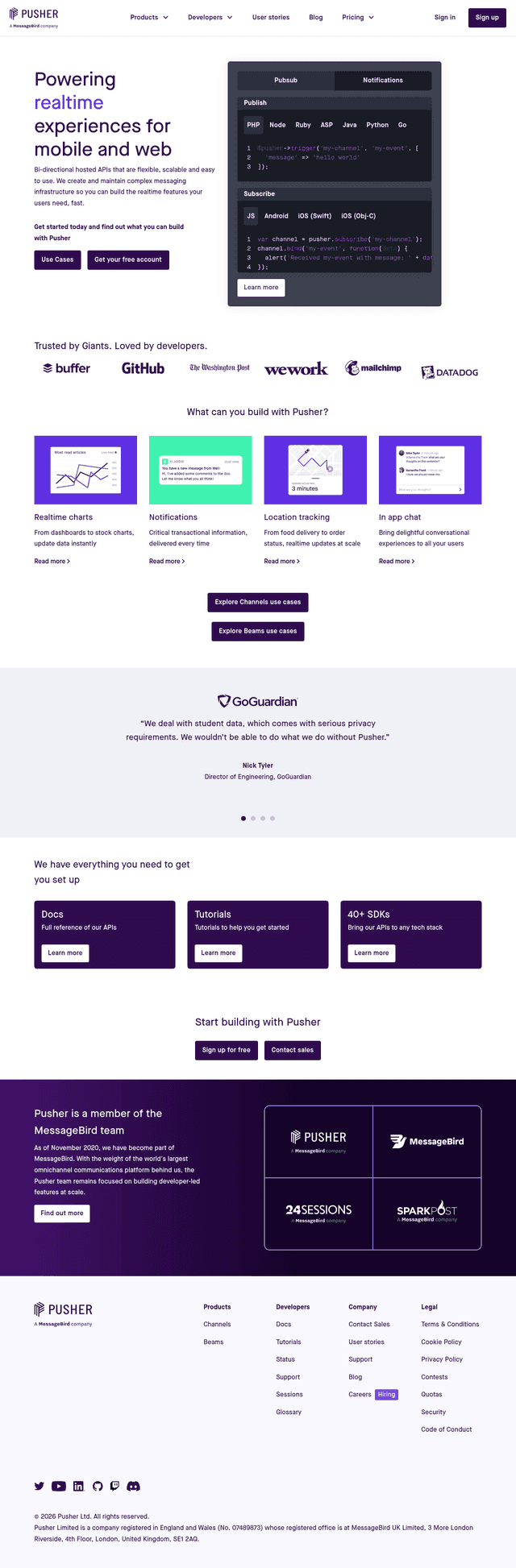
A look at Pusher before the discount, so you can see what the deal saves you.
The Build-Versus-Buy Decision
Real-time infrastructure is a classic build-or-buy call, and Pusher exists on the buy side of it, so weighing that honestly is the point.
Building real-time yourself starts easy. A basic websocket connection that pushes a message is a short prototype. The cost appears in everything after: handling reconnection when clients drop, which they constantly do on mobile networks; scaling websocket servers from a hundred connections to a hundred thousand, which is a genuinely hard distributed-systems problem; managing presence and authorization; and keeping it all running reliably. Each of these is real work, and together they are an infrastructure project that competes with building your product.
Then there is the operational cost. Real-time infrastructure does not just get built; it gets operated, scaled, and kept available, and it fails at the worst moments if neglected. For a company whose product is fundamentally real-time, that investment is the product and worth making. For a company adding a live feature to something else, it is a large, permanent tax on engineering for infrastructure that is not the differentiator.
The calculation is the subscription against the engineering months to build it plus the ongoing operation plus the opportunity cost of what those engineers are not building. For most startups adding real-time features to a product that is not itself real-time infrastructure, buying wins clearly. Build it yourself only if real-time scale is core to your differentiation and you will invest in it as such.
Pusher vs the Alternatives
The hosted real-time space has a few shapes worth knowing.
Simple pub-sub services like Pusher give you channels and event delivery, the primitives, and you build features on top. This is the right level when you want real-time messaging and will construct your own feature logic around it.
Fuller-featured platforms bundle more, chat with UI components, presence, storage, moderation, on top of the real-time layer, which is more to buy but less to build if your need matches what they offer. A dedicated chat platform, for instance, gives you messaging as a finished feature rather than as primitives.
Lower-level infrastructure, or self-hosting an open-source real-time server, offers the most control at the cost of the most work, which is the DIY end of the spectrum.
The choice tracks how much you want built for you. Pusher fits when you want reliable real-time primitives and will build your specific feature on them; a fuller platform fits when your need matches a packaged feature like chat; and DIY fits when control matters more than convenience and you have the capacity for it.
Designing Real-Time Features Well
A few realities separate a live feature that feels solid from one that frustrates users, regardless of the provider.
Connections drop, constantly. Users move between networks, lock their phones, lose signal. A real-time feature has to handle a dropped connection gracefully, reconnect quietly, and recover any state that changed while disconnected. Assuming a stable connection is the most common way real-time features feel broken.
Decide what happens to missed events. Pub-sub delivers to currently-connected clients. A client that was offline when an event fired does not receive it through the real-time channel alone. For events that matter, you need a way to fetch the current state on reconnect, so a user who was briefly offline is not left with a stale view. Design for this rather than assuming every client sees every event.
Do not send everything in real time. Not every update needs to be instant, and pushing high-frequency events to many clients is both expensive and often unnecessary. Reserve real-time for changes users genuinely benefit from seeing immediately, and let the rest load normally. Being deliberate about what is real-time controls both cost and complexity.
Authorize private channels properly. If a channel carries data not everyone should see, it must be a private or presence channel with real authorization on your backend, not a public channel that anyone can subscribe to. Real-time is a data-exposure surface like any other, and getting the authorization wrong leaks data live.
Does the Feature Actually Need Real-Time?
Before adopting any real-time infrastructure, it is worth asking honestly whether the feature needs true real-time, because the answer changes the whole decision and teams often reach for real-time reflexively.
Genuine real-time, where an update must appear within a second of the event, is a real need for a specific set of features: live chat, collaborative editing where users see each other's changes, live dashboards during an event, notifications that must be instant, presence indicators. For these, the persistent connection Pusher manages is the right tool.
Many features that feel like they need real-time do not. A notification count that updates when the user next navigates, a dashboard that refreshes every thirty seconds, a feed that loads new items on pull-to-refresh, none of these require a persistent connection and the infrastructure behind it. Simple periodic polling, asking the server for updates on an interval, is far cheaper and simpler, and for anything that does not need sub-second freshness it is often the better engineering choice despite feeling less sophisticated.
The practical test: if a delay of several seconds, or an update on the next user action, would genuinely harm the experience, you need real-time, and Pusher fits. If a short delay is fine, polling or loading on navigation may serve the need with less cost and complexity. Real-time is a capability to reach for when the latency requirement is real, not a default to apply everywhere, and over-applying it is a common and avoidable source of both cost and engineering complexity.
The corollary is that you can mix approaches. Use real-time for the handful of features that genuinely need instant updates, and ordinary requests for everything else. A product does not have to be real-time everywhere to feel responsive; it has to be real-time in the places where immediacy actually matters to the user.
Who Should Use Pusher?
Use it if you are adding real-time features, notifications, live updates, activity feeds, presence, simple collaboration, to a product where those are features rather than the whole company, and you want to skip building websocket infrastructure.
Use it if you want reliable real-time primitives and will build your specific feature logic on top, which is exactly the level Pusher operates at.
Look elsewhere, or build, if real-time scale is your core product and differentiator, where owning the infrastructure is the point and the investment is justified.
Look elsewhere if your need matches a packaged feature like full chat, where a dedicated platform gives you the finished feature rather than primitives you assemble.
Real Startup Use Cases
A SaaS product added live notifications so users saw updates appear without refreshing, using Pusher channels to push events from the backend to connected clients, shipping in days what building reliable websocket infrastructure would have taken weeks. The feature stayed reliable as concurrency grew because scaling was Pusher's problem, not the team's.
A collaborative tool used presence channels to show which teammates were currently viewing a document, a feature that depends on real-time who-is-online tracking that would have been genuinely hard to build and scale from scratch.
A dashboard product pushed live data updates to connected clients so metrics changed in real time, and was deliberate about pushing only the updates that mattered rather than every change, keeping both the cost and the client complexity manageable.
How to Claim the Credits
- Follow the link on this page to Pusher and create an account.
- Apply the credits and confirm the free-tier limits and balance.
- Estimate your peak concurrent connections and message volume, since those, not user count, drive cost.
- Build one real-time feature using Channels and the SDK for your stack.
- Handle reconnection and missed-event recovery from the start, testing on poor and interrupted connections.
- Use private or presence channels with proper authorization wherever the data is not public.
Tips to Get Value
- Model concurrent connections, not users. The bill tracks simultaneous connections and messages. Estimate your peak, since a product can have many users but few connected at once.
- Handle reconnection deliberately. Connections drop constantly. Graceful reconnect and state recovery are what make a real-time feature feel solid rather than flaky.
- Be selective about what is real-time. Not every update needs to be instant. Reserving real-time for changes users benefit from seeing immediately controls cost and complexity.
- Authorize private channels on your backend. Real-time is a data-exposure surface. Use private and presence channels with real authorization for anything not public.
- Plan for missed events. Pub-sub reaches connected clients only. Give reconnecting clients a way to fetch current state so they are not left stale.
- Do the build-versus-buy math honestly. The comparison is the subscription against engineering months plus permanent operation plus opportunity cost, not against zero.
Who Is This Deal For?
Early-Stage Startups
Seed and pre-seed companies looking to move fast without overspending on tools.
Growing SaaS Teams
Series A+ companies scaling their stack and optimizing software costs.
Solo Founders
Indie hackers and bootstrapped founders who need enterprise tools at startup prices.
Get $500 in credits off Pusher
Premium deal. Upgrade once, unlock everything.
!Eligibility Requirements
Startup needing realtime features
Frequently Asked Questions
Everything you need to know about this startup deal.
Free plan with 200K messages/day and 100 connections. Startup credits give $500 extra.
Get the weekly deals digest
New verified startup deals every week. No spam, ever. Unsubscribe anytime.
Related Offers

Toggl Track
Used by 1,100 members
Free Plan
Simple and intuitive time tracking for teams with reporting and integrations.
View offer
Auth0
Used by 994 members
1 year of B2B Professional free
Get 1 year of the Auth0 B2B Professional plan free, with up to 100,000 monthly active users, SSO, enterprise MFA and SCIM.
View offer
Bugsnag
Used by 471 members
Free Plan
Error monitoring and stability management for web and mobile applications.
View offer
Turborepo
Used by 1,880 members
Free & Open Source
High-performance build system for JavaScript and TypeScript monorepos by Vercel.
View offer
Windmill
Used by 1,501 members
Free Plan
Open-source developer platform for building internal tools, workflows, and scripts.
View offer
Height
Used by 1,442 members
Free Plan
AI-powered project management tool with autonomous task management and workflows.
View offerDeal Summary
Looking for more startup deals?
Browse all offers