
Resend Startup Credits: $300 in credits
Developer-first email API for transactional emails, beautiful emails that actually reach the inbox.
Free · Opens in new tab
Already have an account? Log in
Deal Highlights
What Resend Gives a Startup
Resend is a developer-first email API for transactional email, built to send messages that look good and actually reach the inbox. The deal is $300 in credits for early-stage startups opening a new Resend account, which covers a real volume of sending while the team builds and validates its product. For an early team, that means the emails the product depends on, password resets, receipts, verification links, notifications, get handled by a proper email platform from the start, with the cost covered during the phase when preserving cash matters most.
Transactional email is one of those systems that is invisible when it works and painful when it does not. Almost every product sends it: the confirmation after signup, the reset link when someone forgets a password, the receipt after a purchase. These messages have to arrive, and arrive quickly, because a user is usually waiting for them. Resend exists to make sending them reliable and pleasant for developers, and the $300 in credits lets a startup put that reliability in place early without the bill arriving before the revenue does.

Resend, one of the tools included in this startup deal.
Deliverability That Gets Email to the Inbox
The single most important thing an email API does is get the message to the inbox, and Resend puts deliverability at the center of its pitch. Sending an email is easy. Getting it past spam filters and into the recipient's actual inbox is the hard part, and it is the part that determines whether transactional email does its job. A password reset that lands in spam is a locked-out user and a support ticket. A receipt that never arrives is a confused customer. Deliverability is not a nice-to-have, it is the whole point.
For a startup, deliverability is also something the team is poorly positioned to solve on its own. It depends on sender reputation, proper authentication, infrastructure, and a lot of accumulated know-how about how email providers decide what to trust. Building that up from scratch, especially from a new domain with no reputation, is slow and error-prone. Resend focusing on deliverability means the team leans on a platform built to get email delivered rather than fighting spam filters with a homegrown setup.
This matters because the cost of poor deliverability is silent and steady. Emails that do not arrive do not announce themselves, they just quietly fail, and the team may not notice until users complain that they never got their reset link. A platform whose core job is landing email in the inbox protects the product from that invisible failure. During the credit period, the team can send real transactional email through Resend and see how reliably it arrives, which is the test that matters most.
Built for Developers First
Resend describes itself as developer-first, and that orientation shapes the whole product. Sending transactional email from an application means an engineer integrating an API, and the quality of that developer experience determines how quickly and cleanly the email system gets built. A clean, well-documented API with good libraries lets an engineer add email to the product in a short time, while an awkward one turns a simple need into a frustrating project. Resend aims to be the former.
For a startup, a good developer experience directly translates to time saved. Transactional email is a necessary feature but not a differentiating one, so the faster the team can implement it and move on, the better. A developer-first email API means an engineer wires up the sending, gets it working, and returns to the actual product quickly, rather than wrestling with a clunky integration. That efficiency is exactly what an early team, where engineering time is the scarcest resource, needs from a piece of supporting infrastructure.
The developer-first approach also tends to make the ongoing work easier. Good tooling, clear documentation, and a sensible API mean that when the team needs to add a new type of email, debug a delivery issue, or adjust how something sends, the work is straightforward rather than a struggle. For a small team that will keep touching its email system as the product grows, an API designed to be pleasant to work with keeps that maintenance light. The credit period lets an engineer judge that developer experience directly, by building the product's email on it.
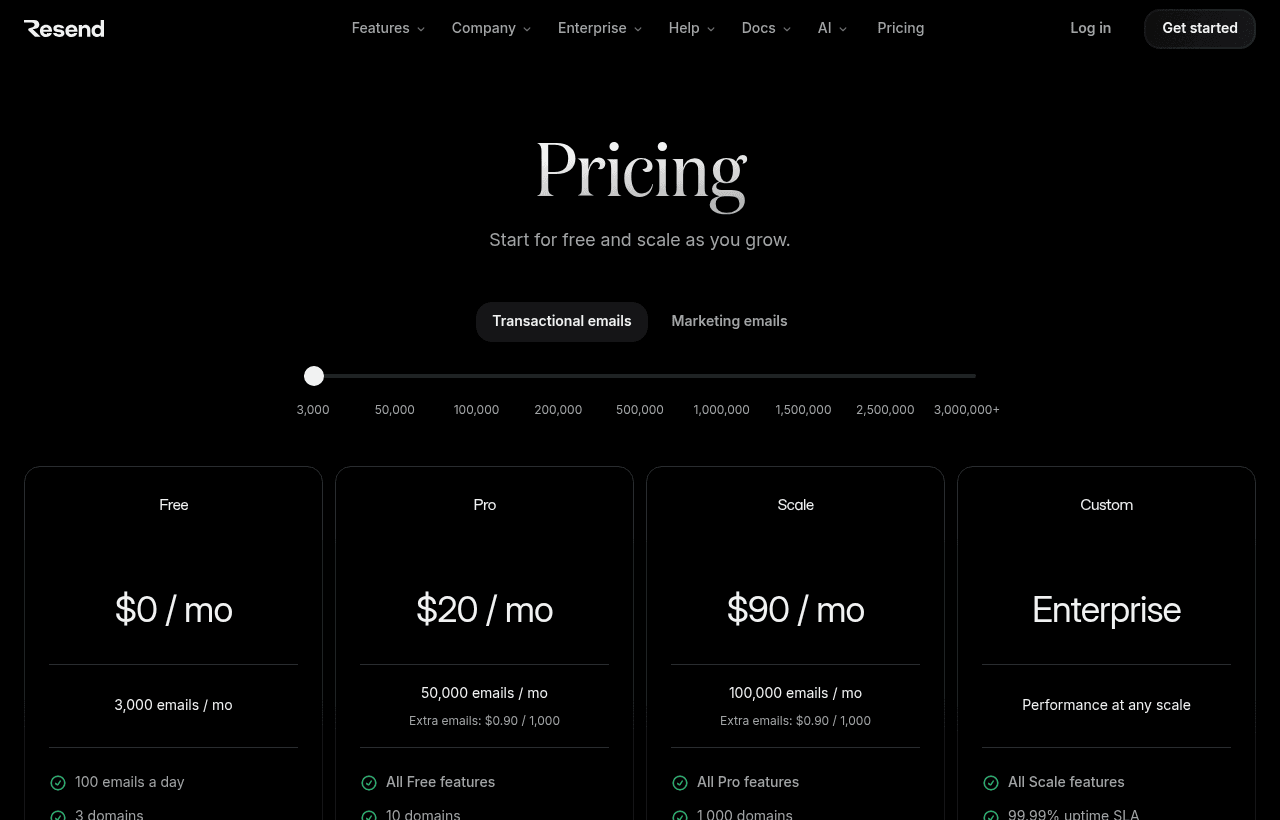
A look at Resend before the discount, so you can see what the deal saves you.
Emails That Look Good
Resend emphasizes beautiful email, and appearance matters more than it might seem for transactional messages. These emails represent the product at important moments: right after someone signs up, when they complete a purchase, when they take an action that matters. An email that looks broken, plain, or unprofessional at those moments undercuts the trust the product is trying to build. Well-designed transactional email reinforces that the product is polished and credible.
For a startup, this is part of the brand experience, delivered at exactly the touchpoints where users are paying attention. A clean, well-designed confirmation or receipt makes the product feel legitimate and cared-for, which contributes to the trust that turns a new signup into a committed user. Resend supporting the creation of good-looking email means the team can send messages that match the quality of the product, rather than settling for the plain, default-looking email that a bare sending setup tends to produce.
This is achievable without a large design or engineering effort, which is what makes it valuable for a small team. The point is that the team does not have to choose between shipping email quickly and shipping email that looks good. Resend being built with the appearance of email in mind means the transactional messages can be both reliable and polished, reinforcing the product's brand at every automated touchpoint. That consistency of quality, from the product into its emails, is exactly what a startup building trust wants.
The $300 in Credits and What They Buy
The $300 in credits is the concrete value of this deal, and its worth is in timing. Early on, a startup is spending before it is earning, and every cost that can be deferred stretches the runway. Transactional email is a real ongoing cost as sending volume grows, and applying $300 in credits to it means the emails the product depends on are covered while the team is still validating and the user base is still growing. The email works from day one without the cost being a concern during the earliest, leanest phase.
For an early team, this removes any hesitation about setting up proper email from the start. Some teams delay adopting a real email platform to avoid the cost, limping along with a makeshift setup that hurts deliverability and appearance. The credits eliminate that trade-off, letting the team put a proper platform in place immediately and send real transactional email without watching a meter. Getting deliverability and polish right early, rather than retrofitting them later, is exactly what the credits enable.
The requirement, an early-stage startup with a new Resend account, matches the credits to the teams they are meant for: young companies setting up their email infrastructure for the first time. For a team that fits, the credits are runway applied directly to a piece of infrastructure every product needs, at the stage when conserving cash for everything else is most important. That is a clean, practical use of a startup's scarce early resources.
Resend Compared to Rolling Your Own Email
The alternative to a dedicated email API is sending email yourself, typically by configuring a mail server or piecing together a basic sending setup. This can look cheaper, but it is where deliverability goes to die. A homegrown setup from a new domain has no sender reputation, often lacks proper authentication, and lands in spam filters that a purpose-built platform is designed to get past. The emails may send, but whether they arrive is another question, and arriving is the whole job.
The other cost of rolling your own is the engineering time and expertise it consumes. Getting email deliverability right is a specialized, ongoing effort involving authentication, reputation management, and infrastructure, and it is knowledge most startup teams do not have and should not have to acquire. Time spent becoming amateur email-deliverability engineers is time not spent on the product, and the result is usually worse than what a dedicated platform provides anyway. It is effort poured into reinventing something that is better bought.
Resend's case is that transactional email is a solved problem worth using a platform for rather than rebuilding. The platform handles the deliverability, provides the developer-friendly API, and supports polished email, so the team gets reliable, good-looking transactional email without the specialized work. For a startup deciding where its limited engineering hours go, offloading email to Resend is almost always the better call, and the $300 in credits makes adopting the proper solution cost-free during the early stage.
Making the $300 in Credits Count
Credits deliver value when they fund real infrastructure rather than idle testing, so the way to use them well is to build the product's actual transactional email on Resend and send real messages through it. The goal during the credit period is to have every email the product depends on flowing through the platform, so the team confirms both deliverability and developer experience on its real workload.
Start by identifying every transactional email the product needs, verification, password reset, receipts, notifications, and implement them through Resend's API. Then send real messages and check that they arrive reliably and quickly across the email providers the team's users actually use, since deliverability can vary by provider. This is the core test: real emails, real inboxes, real delivery. While doing this, invest a little in making the emails look good, so the product's automated messages match its quality from the start.
The engineer doing the integration should pay attention to the developer experience, since the team will keep working with this API as the product grows, and an easy API is worth a lot over time. Sending real volume during the credit period also shows how the platform performs under the product's actual usage. By the time the credits are used, the team should have reliable, polished transactional email fully in place and a clear read on whether Resend is the right long-term home for it, which is exactly what the credits are meant to establish.
How Resend Fits the Product's Architecture
Transactional email is triggered by things happening in the product: a user signs up, resets a password, completes a purchase, or takes an action that warrants a notification. Resend fits this by being an API the backend calls at those moments, which means email slots into the existing application as a straightforward integration rather than a separate system to architect. When an event happens, the backend calls Resend to send the message, and the platform handles getting it delivered. The email layer stays cleanly decoupled from the rest of the product.
This clean fit matters because it keeps the product's architecture simple. The application does not have to run email infrastructure or reason about deliverability, because that lives on Resend's side of the API. The team can add new transactional emails as the product grows by adding new API calls, without expanding any infrastructure it has to maintain. For a small team, keeping email as a simple, well-bounded integration rather than a system to operate is exactly the kind of simplicity that keeps the stack manageable.
It also means the email capability scales with the product without extra engineering. As the user base grows and the volume of transactional email rises, the same integration keeps working, with Resend handling the sending at whatever scale the product reaches. The team does not have to revisit its email setup as it grows, because the platform absorbs the scaling behind the same API. For a startup, having a core piece of infrastructure that fits cleanly and scales quietly is one less thing to worry about as the product takes off.
Who Should Claim This Deal
This deal is built for early-stage startups building a product that sends transactional email, which is nearly every product with user accounts. If the team needs verification emails, password resets, receipts, or notifications to reliably reach the inbox and look professional doing it, Resend's developer-first API plus $300 in credits fits that need directly, and covers the cost during the phase when cash is tightest. The requirement, an early-stage startup with a new Resend account, points the deal at exactly those teams.
It is especially valuable for small teams that want to get email right from the start without spending engineering time on deliverability. Because Resend handles the hard parts, an engineer can implement the product's email quickly and trust it to arrive, and the credits cover the sending while the product is still proving itself. That combination lets a lean team put professional-grade transactional email in place without the cost or the specialized effort it would otherwise take.
Teams whose products genuinely send no email, or who are committed to an existing email platform they are happy with, may not need this. But for an early-stage startup that needs reliable, polished transactional email and wants to avoid the trap of a homegrown setup that lands in spam, this deal is a strong fit. Claim the credits, build the product's real email on Resend, and let the delivery rates and the developer experience confirm whether it is the right foundation for the product's email.
Who Is This Deal For?
Early-Stage Startups
Seed and pre-seed companies looking to move fast without overspending on tools.
Growing SaaS Teams
Series A+ companies scaling their stack and optimizing software costs.
Solo Founders
Indie hackers and bootstrapped founders who need enterprise tools at startup prices.
Get $300 in credits off Resend
Premium deal. Upgrade once, unlock everything.
!Eligibility Requirements
Early-stage startup, new Resend account
Frequently Asked Questions
Everything you need to know about this startup deal.
Yes, free plan with 3,000 emails/month and 1 domain.
Get the weekly deals digest
New verified startup deals every week. No spam, ever. Unsubscribe anytime.
Related Offers

Toggl Track
Used by 1,100 members
Free Plan
Simple and intuitive time tracking for teams with reporting and integrations.
View offer
Auth0
Used by 994 members
1 year of B2B Professional free
Get 1 year of the Auth0 B2B Professional plan free, with up to 100,000 monthly active users, SSO, enterprise MFA and SCIM.
View offer
Bugsnag
Used by 471 members
Free Plan
Error monitoring and stability management for web and mobile applications.
View offer
Turborepo
Used by 1,880 members
Free & Open Source
High-performance build system for JavaScript and TypeScript monorepos by Vercel.
View offer
Windmill
Used by 1,501 members
Free Plan
Open-source developer platform for building internal tools, workflows, and scripts.
View offer
Height
Used by 1,442 members
Free Plan
AI-powered project management tool with autonomous task management and workflows.
View offerDeal Summary
Looking for more startup deals?
Browse all offers