Roboflow Coupon: Free Plan
Computer vision platform for building, deploying, and managing ML models.
Premium: $79/year for unlimited deals
Already have an account? Log in
Deal Highlights
What Roboflow Gives a Startup
Roboflow is a computer vision platform for building, deploying, and managing machine learning models that understand images and video. This deal gives a startup access to the Free Plan, which means a team can go from raw images to a working vision model without paying for the tooling that usually stands in the way. For a company trying to prove that computer vision can solve a real problem, that removes the biggest early obstacle: getting a pipeline stood up at all.
The value is in how much of the hard, unglamorous work Roboflow handles. Computer vision projects rarely die because the idea was wrong. They die because labeling data, wrangling formats, training a model, and getting it to run somewhere useful is a long chain of specialized steps, and any broken link stops progress. Roboflow connects those steps into one platform, so a small team can carry a project from a folder of images to a deployed model without stitching together five separate tools.
For a startup, the Free Plan is the ideal way to validate. A team can label a first dataset, train an initial model, and see real results on their own images before deciding whether vision is worth building a product around. That is exactly the kind of low-risk proof an early company needs before it commits engineering time and money.
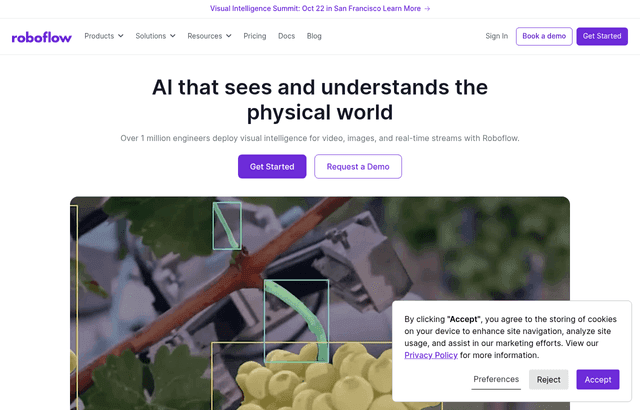
Roboflow, one of the tools included in this startup deal.
From Raw Images to Labeled Data
Every computer vision model starts with labeled data, and labeling is where most projects bog down. A model that detects defects, counts objects, reads a scene, or spots a specific item first has to be taught with examples that a human has marked up. Roboflow gives a startup the tools to do that annotation directly in the platform, with an interface built for drawing boxes, marking regions, and tagging classes at speed.
That matters because labeling is often the single largest cost in a vision project. A team that can annotate efficiently, review each other's work, and keep labels consistent will reach a usable model far faster than one fighting a clumsy process. Roboflow is designed to make that first dataset come together quickly, which is where momentum on a vision project is won or lost.
The platform also helps a startup manage data as it grows. Images can be organized, versioned, and split into training and validation sets, so the team always knows what the model learned from. As new images come in from real usage, they can flow back into the dataset to make the next version better. That loop, where real-world data continuously improves the model, is how vision systems get good, and Roboflow gives a small team the structure to run it.
Handling the Formats and Preprocessing Nobody Wants to Do
Computer vision is plagued by format problems. Different frameworks and models expect data in different layouts, annotations in different schemas, and images in different sizes and orientations. A team can lose days just converting between them. Roboflow absorbs that pain by handling format conversion and preprocessing automatically, so a startup's engineers spend their time on the problem instead of on plumbing.
Preprocessing and augmentation are built in. The platform can resize, normalize, and transform images, and generate augmented variations that make a model more robust without the team collecting more data. For an early company with a limited dataset, augmentation is a genuine multiplier, because it squeezes more learning out of every image already labeled. That means better models from smaller datasets, which is exactly the position a startup is usually in.
By taking these steps off the team's plate, Roboflow lets a small group move at a pace that would normally require a dedicated machine learning engineer. The generalists a startup actually has can get real work done, because the platform handles the specialized preparation that would otherwise stall them.
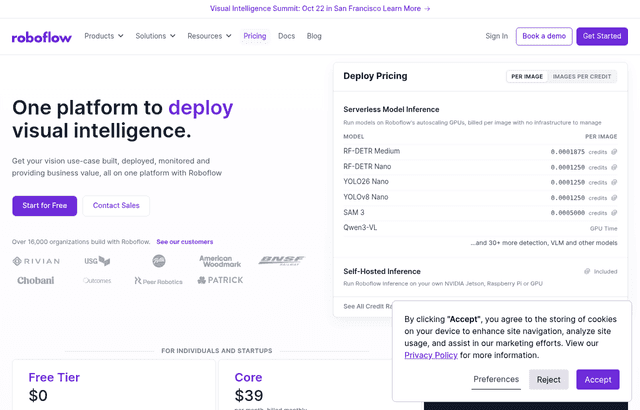
A look at Roboflow before the discount, so you can see what the deal saves you.
Training and Managing Models Without a Research Team
Once data is labeled and prepared, a startup needs a model, and training one from scratch is deep, specialized work. Roboflow shortens that path dramatically. The platform lets a team train models on their dataset and evaluate how well they perform, without requiring the team to hand-build training pipelines or stand up their own GPU infrastructure just to get a first result.
That changes the economics of trying. A startup can test whether a vision approach even works on their problem in days, not months. If the first model is promising, the team keeps investing. If it is not, they have learned that cheaply and can pivot. Either outcome is valuable, and both are only affordable because Roboflow removes the heavy lifting from the experiment.
Model management is part of the platform too. As a team produces multiple versions, Roboflow keeps track of what was trained on which dataset and how each performed, so the team can compare versions and know which one is actually better. That discipline keeps a project from turning into a pile of undated model files nobody can tell apart, which is a real risk when a small team is moving fast.
Deploying the Model Where It Needs to Run
A model that only runs in a notebook is a science project, not a product. The value of computer vision shows up when the model runs against real images in a real application, whether that is on a server, at the edge on a device near a camera, or inside a product's own software. Roboflow is built to close that last gap, giving a startup ways to deploy trained models and call them from their application.
For an early team, deployment is often the step where momentum dies, because getting a model to run reliably outside the training environment is its own discipline. Roboflow reduces that friction so a startup can get inference happening in their product without building deployment infrastructure from the ground up. That means the path from idea to something a user or a system actually interacts with is far shorter.
Being able to deploy also completes the feedback loop. Once a model is running against real inputs, the team sees where it succeeds and where it fails, feeds the hard cases back into the dataset, and trains a better version. That cycle is the engine of a good vision product, and Roboflow gives a startup every stage of it in one place.
Roboflow Compared to Building the Pipeline Yourself
A startup could assemble a computer vision pipeline from open-source parts. Annotation tools exist. Training frameworks exist. Deployment options exist. The catch is that gluing them together, keeping formats aligned, managing datasets and versions, and maintaining the whole chain is a substantial ongoing job that pulls engineers away from the actual product.
Roboflow's advantage is integration. Labeling, preprocessing, augmentation, training, versioning, and deployment live in one platform that already fits together, so a small team is not spending its scarce engineering hours being a machine learning operations team. For a startup, that trade is almost always worth it, because the goal is to prove and ship a vision feature, not to build and maintain infrastructure that provides no differentiation.
Compared to hiring a specialized machine learning team up front, Roboflow lets a startup delay that expense until there is proof the bet is worth it. The generalists on the team can get a real model working on the Free Plan, demonstrate value, and only then decide whether the problem justifies deeper investment. That sequencing, prove first and invest second, is how a capital-efficient company should approach any hard technical bet.
Making the Free Plan Count
The Free Plan is an invitation to prove something concrete, and the teams that get the most from it treat it as a focused experiment rather than open-ended tinkering. Start by defining exactly what the model should do and what a good result looks like. Detecting one specific object, counting items in a frame, or flagging a particular condition is a far better first project than a vague ambition to add computer vision.
Then get a first dataset labeled fast. Even a modest set of well-labeled images is enough to train a first model and see whether the approach is viable. Use the platform's preprocessing and augmentation to get more out of that initial data, and train an early version to establish a baseline. The point is to reach a real result quickly, because a working baseline tells a startup more than weeks of planning ever could.
From there, iterate. Look at where the model fails, gather more examples of those cases, and train again. A few cycles of this loop usually reveals whether the problem is tractable with the data a startup can realistically collect. By the end, the team has either a working model worth building on or clear evidence to redirect effort elsewhere, and both outcomes justify the time spent.
How Roboflow Fits a Startup's Roadmap
Computer vision is rarely a company's whole product, but it is often a feature that makes the product noticeably better or opens a market the team could not serve otherwise. Roboflow fits that reality by letting a startup add vision capability as a component, without turning the whole company into a machine learning shop. The team can keep its focus on the product while treating the model as one part that Roboflow helps them build and maintain.
As the product grows, the same platform supports a maturing vision effort. Datasets get larger, models get better, and the retraining loop becomes a routine part of operations rather than a one-off experiment. Because Roboflow already spans the full pipeline, a startup can deepen its investment without switching tools or rebuilding the process, which keeps the cost of scaling the vision feature manageable.
That continuity is valuable for a small company. Starting on the Free Plan and growing into more serious usage on the same platform means the early experiments are not throwaway work. The datasets, labels, and workflows built during validation carry straight into production, so the effort compounds instead of being repeated.
Getting Started in the First Week
The fastest way to get value from Roboflow is to reach a real result early, not to plan the perfect project. In the first few days, upload a small set of images that represent the problem the team wants to solve and start labeling. Even a couple of hundred well-annotated images is enough to train a first model and learn whether the idea holds. Getting hands on the data quickly teaches a team more than any amount of theorizing about architectures.
Once a first dataset is labeled, use the built-in preprocessing and augmentation to prepare it, then train an initial model to set a baseline. Look closely at where it performs and where it fails. Those failures are not setbacks, they are a shopping list for the next round of data collection. Gather more examples of the hard cases, add them to the dataset, and train again. Two or three passes through this loop usually make the direction clear.
Keep the first project narrow on purpose. A tightly scoped goal, like detecting one object or flagging one condition, produces a clean signal about whether vision works for the team's problem. Once that first model proves the concept, a startup can widen the scope with confidence, because the whole pipeline from labeling to deployment is already familiar and running. Momentum from one working model carries the project further than a broad, unfocused start ever would.
Who Should Claim This Deal
This deal fits any startup where images or video carry information the product needs to understand. Teams building inspection, monitoring, counting, recognition, or scene-understanding features will find that Roboflow covers the whole path from raw images to a deployed model, which is exactly the span that usually stops a small team.
It is a strong match for companies without a dedicated machine learning team, because the platform lets generalist engineers accomplish work that would otherwise require specialists. It suits teams that need to validate a vision idea before committing serious resources, since the Free Plan makes it possible to label data, train a model, and see real results at no cost. And it fits any startup that wants to keep its engineers focused on the product rather than on maintaining a fragile, hand-built pipeline.
If a startup has no use for computer vision, this deal will sit idle, and other tools will serve the team better. But for any company where understanding images or video is part of the plan, Roboflow turns a long, specialized process into something a small team can actually do, and the Free Plan is the no-risk way to prove the idea before spending real money on it.
Who Is This Deal For?
Early-Stage Startups
Seed and pre-seed companies looking to move fast without overspending on tools.
Growing SaaS Teams
Series A+ companies scaling their stack and optimizing software costs.
Solo Founders
Indie hackers and bootstrapped founders who need enterprise tools at startup prices.
Get Free Plan off Roboflow
Premium deal. Upgrade once, unlock everything.
Frequently Asked Questions
Everything you need to know about this startup deal.
Yes, free plan with 1,000 images and 3 projects.
Get the weekly deals digest
New verified startup deals every week. No spam, ever. Unsubscribe anytime.
Related Offers

Higgsfield
55% off annual Business plan
55% off an annual Higgsfield Business plan. Higgsfield is an AI video and image studio with Seedance, Kling, Veo and more in one account.
View offer
Seedance
55% off annual Business plan
55% off an annual Higgsfield Business plan with Seedance included. Seedance is ByteDance's AI video model for text, image and reference-driven clips.
View offerChromaDB
Used by 306 members
Free & Open Source
Open-source embedding database for building AI applications with semantic search.
View offer
Laxis
Used by 2,176 members
Free Plan
AI meeting assistant that records, transcribes, and generates actionable meeting notes.
View offer
Pictory
Used by 659 members
Free Trial
AI-powered video creation tool, turn text, scripts, and blogs into videos.
View offer
Segment
Used by 2,293 members
$25,000 in credits
Collect, clean, and route customer data to every tool in your stack with the leading customer data platform.
View offerDeal Summary
Looking for more startup deals?
Browse all offers