
Tally Coupon: Free forever
Free form builder, unlimited forms, responses, and features with no paywall. The anti-Typeform.
Free · Opens in new tab
Already have an account? Log in
Deal Highlights
What Tally Gives a Startup
Tally is a free form builder with an unusual promise: unlimited forms, unlimited responses, and its features available without a paywall standing between the team and the thing it needs. It calls itself the anti-Typeform, and the deal is that it is free forever. The requirement is simply any startup needing forms, which is every startup, because forms are one of those quiet necessities that show up everywhere a company collects information from people.
The problem Tally addresses is that forms are essential but the tools for making them have historically been stingy. Most form builders lure a team in with a free tier and then cap the number of responses, lock the useful features behind an upgrade, or limit how many forms can exist. A startup builds a form, it starts working, responses come in, and suddenly the tool demands payment right at the moment the form is proving valuable. That pattern turns a basic utility into a recurring cost and a source of friction.
Tally flips that. It gives unlimited forms and unlimited responses with its features open rather than gated, at no cost. For a startup, that means forms stop being something to ration. The team can make as many as it needs, collect as many responses as come in, and use the features it wants, without watching a meter or hitting a wall. Forms become a free, unlimited utility the team reaches for whenever collecting information is the task, which is often.
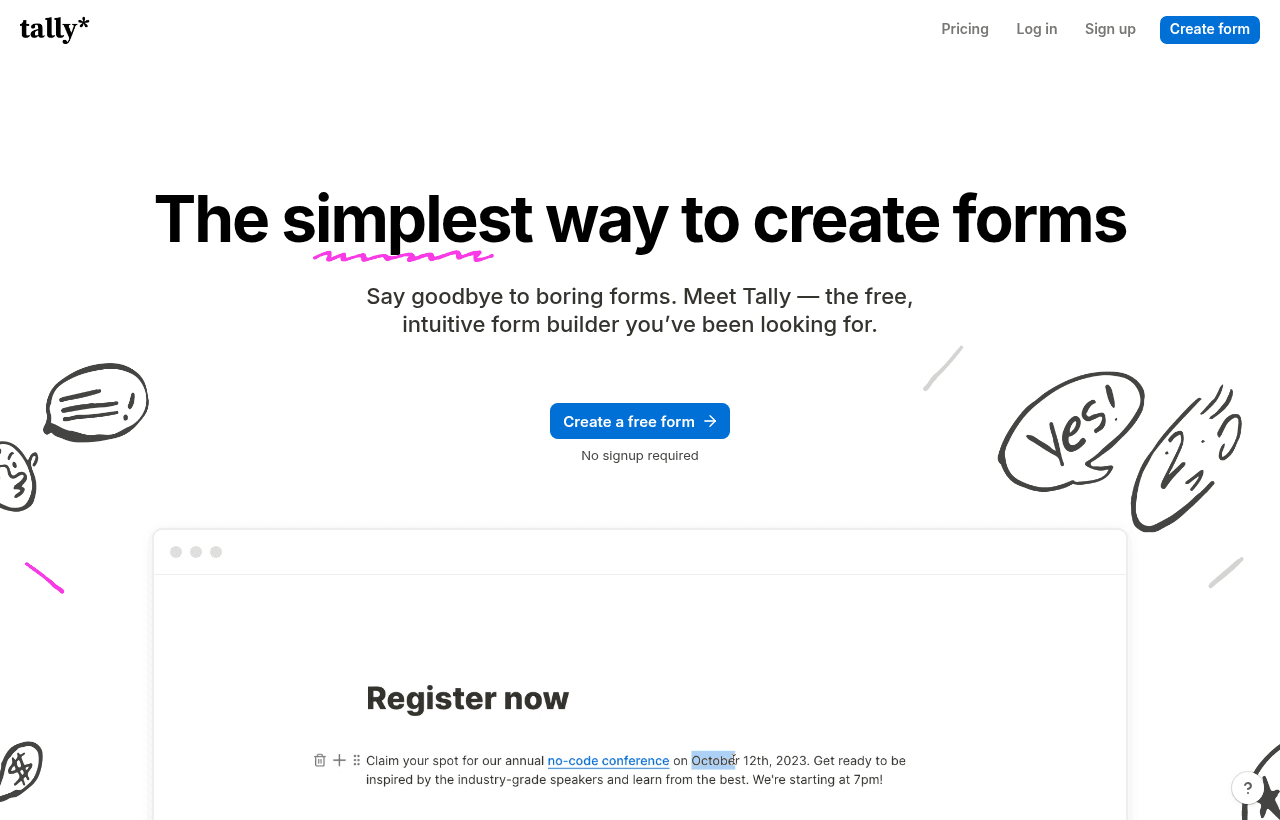
Tally, one of the tools included in this startup deal.
Unlimited Forms and Responses Without a Meter
The heart of Tally's value is the word unlimited. Unlimited forms means the team never has to decide which forms are worth creating and which are not, because there is no cap to ration. Unlimited responses means a form that succeeds does not become a liability the moment it gets popular. Together these remove the anxiety that most form tools quietly impose, where using the tool more, which is what success looks like, costs more or gets cut off.
For a startup, this changes the relationship with forms entirely. When forms are metered, teams hesitate. They avoid making a form for a small need because it is not worth a slot. They worry when a form gets a lot of responses because they are approaching a limit. They design around the constraints of the tool rather than around what they actually want to collect. Tally removes that whole layer of second-guessing. A form is free to make and free to collect, so the only question is whether the team needs the information, not whether the tool will allow it.
This is particularly valuable because forms tend to multiply. A startup ends up needing a contact form, a waitlist signup, a feedback survey, a job application form, an event registration, a lead capture form, and more, and each of those is a separate form. On a metered tool, that proliferation runs into limits fast. On Tally, it does not. The team can spin up whatever forms it needs across the whole company without the count ever becoming a problem, which is exactly the freedom a growing startup wants from a basic tool.
Features Open Instead of Paywalled
Tally's other core promise is that its features are available rather than trapped behind an upgrade. Many form builders make the free tier deliberately frustrating, holding back the features that make forms actually useful so that the team is nudged toward paying. Tally's approach is to make the features open, so a startup gets a capable form builder rather than a crippled demo of one.
This matters because a form is only as useful as what it can do. Conditional logic that shows the right questions based on earlier answers, different question types for different kinds of information, the ability to make forms that look good and work well, these are the things that separate a form people abandon from a form people complete. When those capabilities are paywalled, the free tier produces weak forms, and the team either settles for less or pays up. When they are open, as with Tally, the team can build genuinely good forms for free.
For a startup, having the real features available at no cost means the forms it builds are effective, not just present. A well-built form with sensible logic collects better information and gets completed more often than a bare one. Tally lets a small team produce forms of real quality without a budget, which raises the outcome of everything the startup does with forms, from collecting leads to gathering feedback, without asking the team to pay for the privilege of doing it well.
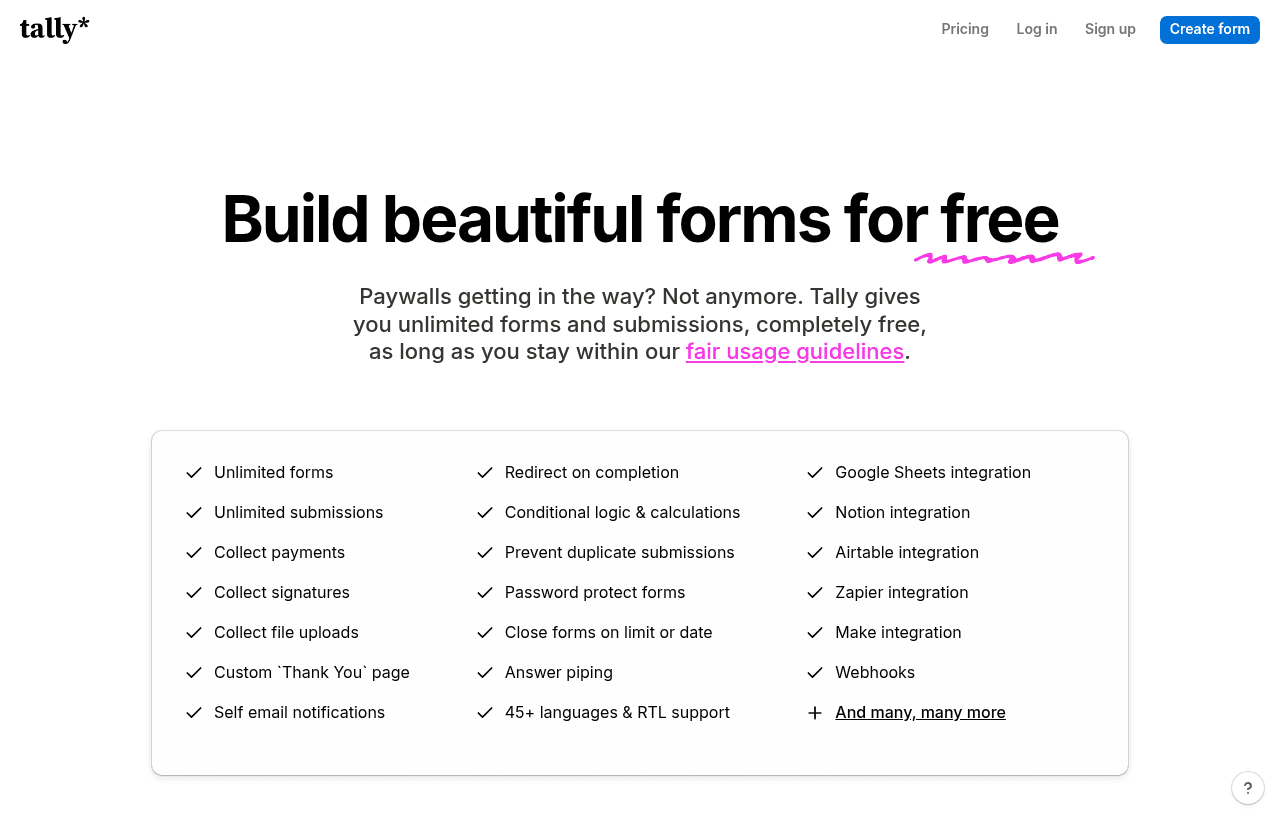
A look at Tally before the discount, so you can see what the deal saves you.
Where Forms Show Up Across a Startup
Forms are deceptively pervasive in a startup, and Tally's unlimited, free model fits that pervasiveness perfectly. In marketing, forms capture leads, collect waitlist signups, and register people for events. In product, forms gather user feedback, run surveys, and collect feature requests. In operations, forms handle job applications, intake requests, and internal data collection. In sales, forms qualify leads and collect the information needed to follow up. Each of these is a form, and each is a place where Tally can serve without cost or limit.
Because the tool is free and unlimited, a startup can use it consistently across all of these functions rather than picking and choosing where a form is worth the cost. That consistency has its own value. When every team reaches for the same form tool, the company builds up a shared way of collecting information, and nobody is blocked from making a form because it would push the account over a limit or require an upgrade. The utility is available to everyone, everywhere, all the time.
This breadth is what makes a free, unlimited form builder more valuable than it first appears. It is not just a tool for one occasional task. It is infrastructure that quietly supports lead capture, feedback, hiring, registration, and internal operations across the whole company. A startup that adopts Tally has that entire surface covered by one free tool, which removes a small recurring cost and a set of small frictions from many different parts of the business at once.
Forms That People Actually Complete
Collecting information only works if people finish the form, and abandonment is the enemy of every form. A form that is ugly, confusing, or asks too much gets started and left. Tally is built to produce forms that are pleasant to fill out, which directly improves completion, and completion is what turns a form from a hopeful gesture into a source of real data.
For a startup, completion rate is the difference between a lead capture form that fills the pipeline and one that leaks it, between a feedback survey that yields insight and one that yields silence. A form that respects the person filling it out, that is clean and clear and does not demand more than necessary, gets finished more often. Because Tally's features are open, a startup can build these good forms for free, using logic to keep forms short and relevant and design to keep them approachable, rather than settling for a clunky free-tier form that people bail on.
This is where the combination of unlimited use and open features pays off together. The team can make many forms, and it can make each of them good. The result is not just more forms but more completed forms, which means more leads, more feedback, more applications, and more of whatever the startup was trying to collect. A form tool that is both free and capable lets a small team run effective data collection across the company without either a budget or a compromise on quality.
Tally Compared to Typeform and Other Paywalled Builders
Tally positions itself as the anti-Typeform, and the comparison is instructive. Typeform and similar tools are polished and capable, but they are built around a paywall. The free tier is limited, responses are capped, and the features that make forms genuinely useful often require a paid plan. The model is to get a team hooked on a form and then charge as the form succeeds, which means the more valuable a form becomes, the more it costs.
For a startup watching its spending, that model is exactly backwards. A young company wants its costs to scale with revenue, not with the success of a contact form. A form builder that charges more as more people fill out the form turns a basic utility into a growing expense, and the team ends up either paying for something that should be simple or contorting itself to stay under the limits. The paywalled builders are optimized to extract payment at the moment of the team's success.
Tally's alternative is to make the core promise, unlimited forms, unlimited responses, open features, free. The team is not managing against caps or deciding whether a form is worth an upgrade. It just makes the forms it needs. For a startup, that difference is not only about saving money, though it is that. It is about removing an entire category of friction and second-guessing from a task that should be trivial. A form is a form, it should be free to make and free to collect on, and Tally is the builder that treats it that way.
No Reason to Ration a Free Tool
Because Tally is free forever with unlimited forms and responses, the strategic move for a startup is simply to stop rationing forms and use them freely wherever they help. There is no credit to spend carefully, no trial to race against, and no limit to plan around. The tool rewards use rather than punishing it, so the team should lean into that.
The practical approach is to make Tally the default form tool across the company and let every function use it as needed. When marketing wants a lead form, when product wants a feedback survey, when operations wants a job application form, the answer is the same free tool, with no approval needed because there is no cost and no limit to worry about. That default removes the small decisions and small expenses that would otherwise accompany each new form on a paywalled tool.
Because the features are open, the team should also take the time to build good forms rather than minimal ones, using logic to keep them relevant and design to keep them completable. The cost of a better form is only a little more effort, not more money, so there is no reason to settle for a weak one. Over time, a startup that adopts Tally this way ends up with effective, well-built forms supporting every part of the business, collecting the information the company needs, at no cost and with no ceiling. The utility is simply always available.
Getting Started Is Nearly Free of Friction
Adopting Tally is low-effort by design, which suits a tool meant to be used broadly and casually. A startup can start building a form right away, without a procurement decision or a budget conversation, because there is nothing to buy. That low barrier is part of what makes the tool spread naturally across a team: anyone who needs a form can make one, so forms get made whenever they are useful rather than only when they clear some cost hurdle.
For a small team, this ease of adoption matters. Tools that require setup, payment, or approval tend to get used less than they should, because the friction of starting deters people from small, worthwhile tasks. A free tool that anyone can pick up and use immediately gets used for exactly those small, worthwhile tasks that would otherwise be skipped. A quick feedback survey, a simple signup form, a one-off registration, these all get made because making them is trivial and free.
The result is a startup that collects information more readily across the board. When making a form is this easy and this free, the team defaults to gathering data rather than guessing, because the cost of asking is nearly zero. That habit, of reaching for a form whenever a question could be answered by collecting responses, is a healthy one for a young company trying to learn about its users and its market, and Tally makes that habit frictionless.
Who Should Claim This Deal
Tally fits the requirement exactly: any startup needing forms, which is every startup. If the team collects leads, gathers feedback, runs surveys, accepts job applications, registers people for events, or captures information from users in any way, it needs forms, and Tally provides them free, unlimited, and capable.
It is especially valuable for cost-conscious early teams that do not want a basic utility turning into a recurring expense that grows as their forms succeed. It suits companies that use forms across many functions, marketing, product, operations, sales, because one free unlimited tool covers all of them without limits or per-team costs. And it fits any team frustrated by the paywall model of other builders, where the useful features and the response capacity are held hostage behind an upgrade.
Since Tally is free forever with unlimited forms and responses and open features, there is no cost to adopting it and no reason to ration its use. Make it the default form tool, use it freely across the whole company, and take advantage of the open features to build forms people actually complete. A startup that does this gets effective data collection everywhere it needs it, with no meter, no paywall, and no ceiling, which is exactly what a basic utility should be.
Who Is This Deal For?
Early-Stage Startups
Seed and pre-seed companies looking to move fast without overspending on tools.
Growing SaaS Teams
Series A+ companies scaling their stack and optimizing software costs.
Solo Founders
Indie hackers and bootstrapped founders who need enterprise tools at startup prices.
Get Free forever off Tally
Premium deal. Upgrade once, unlock everything.
!Eligibility Requirements
Any startup needing forms
Frequently Asked Questions
Everything you need to know about this startup deal.
Yes, unlimited forms and submissions for free.
Get the weekly deals digest
New verified startup deals every week. No spam, ever. Unsubscribe anytime.
Related Offers

Drip
Used by 1,080 members
Free Trial
Email marketing automation platform built for e-commerce and direct-to-consumer brands.
View offer
SurveyMonkey
Free plan
Free SurveyMonkey Basic plan: unlimited surveys, 10 questions per survey and AI survey building. Upgrade only when you need more responses.
View offer
Klaviyo
Used by 3,980 members
Free Plan
Get the Klaviyo Free Plan, the email and SMS marketing platform that powers most of the top Shopify stores, with deep ecommerce data, predictive analytics, and pre-built revenue flows.
View offer
SpyFu
Used by 458 members
Free Trial
Competitive intelligence tool for SEO and PPC, analyze competitor keywords and ads.
View offer
Sprout Social
Used by 947 members
Free Trial
Enterprise social media management platform with analytics and engagement tools.
View offer
Omnisend
Used by 1,442 members
Free Plan
Omnichannel marketing automation for e-commerce, email, SMS, push, and more.
View offerDeal Summary
Looking for more startup deals?
Browse all offers