
Temporal Startup Credits: $500 in credits
Durable execution platform, run reliable, long-running workflows that survive failures and restarts.
Premium deal
Already have an account? Log in
Deal Highlights
The SaaSOffers Temporal deal
Offer: $500 in credits for Temporal Cloud.
Who qualifies: a startup with complex async workflows.
There is no promo code. You claim the credit through the SaaSOffers deal page.
We checked these plans and prices against Temporal's official pricing and help pages in November 2026.
Temporal is a durable execution platform. You write workflows as ordinary code, and Temporal records each step so a workflow resumes where it stopped after a crash, a deploy or a downstream outage. The server is open source under the MIT license. Temporal Cloud is the hosted version, billed by usage.
Read this before you claim: Temporal's own offers are larger than ours for many startups. Every new Temporal Cloud account gets $150 in free credits that expire after 90 days. And the Temporal Startup Program gives $6,000 in Temporal Cloud credits to startups that raised $30M or less within the last 3 years. If you have raised funding, apply to Temporal's program directly. Our $500 is most useful if you are bootstrapped or otherwise outside that program, and you should confirm its terms when you redeem, because Temporal's site does not mention it.
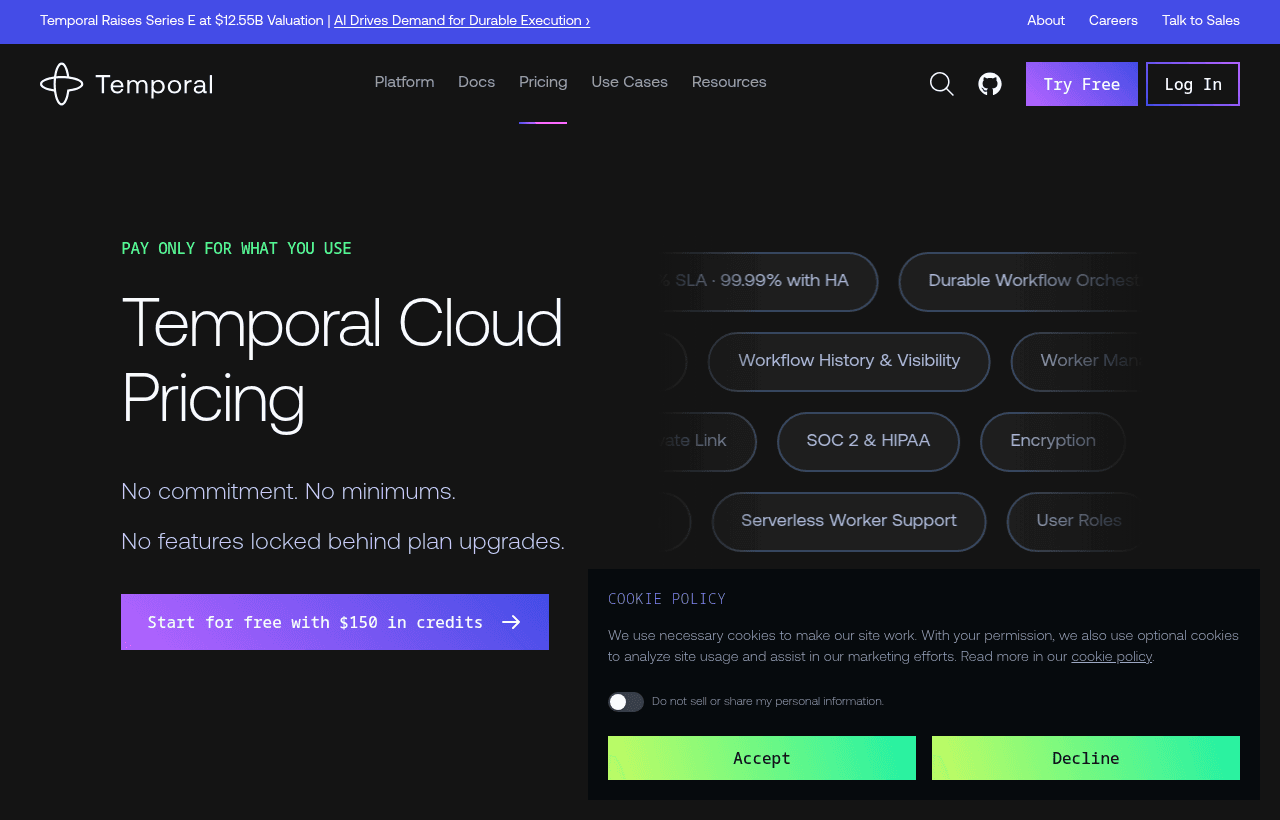
Temporal Cloud has no free tier, only starting credits
There is no permanent free plan on Temporal Cloud. The pay-as-you-go plan has no base fee, so a month with zero usage costs $0. But every Action and every GB-hour of storage is billed once the $150 starting credit runs out or expires. A credit card is required to sign up for Temporal Cloud. Temporal says the card is not charged in the first 90 days while credits remain.
What the starting credits and the entry plan do not include:
- No credits after day 90. Unused starting credit expires.
- No fast support. The entry plan has a 1-business-day P0 response target.
- Volume discounts on the entry plan are unclear. Temporal's pricing page says "Self service down to $25 per million actions" on the Pay-As-You-Go card. Its pricing docs say the Developer plan pays $50 per million Actions at every volume, with the tiered discounts on Business and above. We use the flat $50 rate below. Ask Temporal which applies before you budget for more than 5M Actions a month.
- No SCIM. Temporal lists it as an add-on, priced at $500 per month on Business. It is included from Enterprise up.
- No long retention. Closed workflow history is kept for up to 90 days. Longer retention needs the Export feature, which itself generates billable Actions.
If you want to avoid the bill entirely, the self-hosted Temporal Service is free from Temporal. You then pay for and run your own servers and database.
Temporal Cloud plans and prices
Temporal calls these support plans. Each one adds support and, from Business up, a monthly allowance of Actions and storage.
| Plan | Billed yearly | Billed monthly | Key limits |
|---|---|---|---|
| Pay-as-you-go (Developer support) | No yearly plan | $0 base; support is 10% of usage | $50 per million Actions (flat per Temporal's docs; the pricing page shows discounts down to $25), 1-business-day P0 response, 500 Actions per second on demand |
| Business | 1, 2 or 3-year commitment discounts (rates not published) | Greater of $500 or 10% of usage | Includes 2.5M Actions, 2.5 GB Active Storage, 100 GB Retained Storage; 2-business-hour P0 response |
| Enterprise | Annual contract, contact sales | Not sold monthly | Includes 10M Actions, 10 GB Active, 400 GB Retained; P0 under 30 minutes 24/7; SCIM included |
| Mission Critical | Annual contract, contact sales | Not sold monthly | Same allowance as Enterprise; P0 under 15 minutes; dedicated platform architect |
Actions and storage are the real bill
Temporal does not charge per seat or per workflow. It charges per Action and per GB-hour of event history.
What counts as an Action
An Action is a billable operation between your app and Temporal Cloud. Temporal lists these:
- Starting, resetting or continuing a workflow, including Continue-As-New and Child Workflows
- Each Activity start or retry (all Local Activities in one Workflow Task count as one Action)
- Each Timer, including implicit timeouts set through the SDK
- Each Signal, Update and Query
- Exports, Nexus calls, Scheduled Workflows and Batch jobs
Actions created during Workflow Replay are not billed.
Action prices above the plan allowance
| Actions per month | Price per million |
|---|---|
| First 5M | $50 |
| Next 5M (up to 10M) | $45 |
| Next 10M (up to 20M) | $40 |
| Next 30M (up to 50M) | $35 |
| Next 50M (up to 100M) | $30 |
| Next 100M (up to 200M) | $25 |
| Over 200M | Contact sales |
Storage
Storage is measured in GB-hours, and 1 GB held for a month is 744 GBh. Active Storage (open workflows) costs $0.042 per GBh. Retained Storage (closed workflow history) costs $0.00105 per GBh. So 1 GB of open-workflow history for a full month costs $31.25, and 1 GB of closed history costs $0.78.
Multipliers that change the math
- High availability replicas apply a 2x multiplier to Actions and storage in the replicated namespace.
- Task Queue Fairness adds 0.1 Action per Action for each hour it is on, whether you use fairness keys or not. Temporal's example: 10,000 Actions an hour becomes 11,000 billed Actions.
- Provisioned capacity adds 500 Actions per second per Temporal Resource Unit. Each TRU beyond the default needs at least 360,000 Actions per hour, or Temporal bills the shortfall.
What the credit is worth, worked out
These examples use Temporal's published prices and the pay-as-you-go plan unless stated. They assume our $500 credit applies in full, which you should confirm when you redeem.
Example 1: an early product
A startup runs 2M Actions a month, holds 1 GB of open-workflow history, and keeps 10 GB of closed history.
- Actions: 2M x $50 per million = $100
- Active Storage: 744 GBh x $0.042 = $31.25
- Retained Storage: 7,440 GBh x $0.00105 = $7.81
- Usage subtotal: $139.06
- Support at 10%: $13.91
- Total: $152.97 per month, or $1,835.64 a year
Temporal's $150 starting credit covers about the first month. If our $500 applies, it covers 500 / 152.97 = about 3.3 months. Temporal's $6,000 startup credit would cover this workload for about 39 months, if you qualify.
Example 2: a busier product, two plans compared
A team runs 12M Actions a month with 3 GB of open history and 50 GB of closed history.
On pay-as-you-go:
- Actions: 12M x $50 = $600
- Active Storage: 2,232 GBh x $0.042 = $93.74
- Retained Storage: 37,200 GBh x $0.00105 = $39.06
- Support at 10%: $73.28
- Total: $806.08 per month
If the tiered rates also apply on pay-as-you-go, as the pricing page suggests, Actions cost 5M x $50 + 5M x $45 + 2M x $40 = $555. The total is then $687.80 + $68.78 support = $756.58 a month.
On Business:
- Actions beyond the 2.5M included: 9.5M, billed 5M x $50 = $250 plus 4.5M x $45 = $202.50, so $452.50
- Active Storage beyond 2.5 GB: 0.5 GB = 372 GBh x $0.042 = $15.62
- Retained Storage: 50 GB is inside the 100 GB included, so $0
- Plan fee: greater of $500 or 10% of $468.12, so $500
- Total: $968.12 per month
At this volume, Business costs $162.04 more per month, or $211.54 more if pay-as-you-go gets the tiered rates. You pay it for the 2-business-hour support target, not for lower usage prices. Our $500 credit would cover 62% of one pay-as-you-go month here.
For scale, Temporal's docs size a "Small" workload at under $50 a month and under 1M Actions, and a "Medium" one at under $2K a month and under 40M Actions.
What you get on every plan
Temporal says no features are locked behind plan upgrades. Every plan includes:
- Durable workflow orchestration with automatic retries, four timeout classes, heartbeating and saga compensation
- Durable Timers that can sleep for months, and cron Schedules with backfill
- Signals, Queries and Updates to read or change a running workflow
- Child Workflows and Temporal Nexus for calls across teams
- Worker Versioning and Replay tests for safe deploys
- SSO via SAML, user roles, API keys, service accounts and audit logging
- Private Link, encryption, SOC 2 and HIPAA
- A 99.9% SLA, or 99.99% with high availability
- SDKs for Go, Java, Python, TypeScript, .NET, PHP and Ruby. The pricing page also lists Rust.
Billing details: invoices go out on the 3rd of each month for the previous month. Temporal accepts credit card, ACH, wire transfer and UPI, and sells through AWS Marketplace. Canceling deletes your account data permanently.
Teams that fit Temporal
- Teams running payment, provisioning or order flows where a half-finished process costs money. Temporal retries failed steps and does not repeat finished ones.
- AI agent builders. Temporal runs OpenAI Agents SDK and Google ADK calls as durable Activities, in preview. Replit and Lindy publish case studies with Temporal.
- Backends with long waits, such as trials that convert after 14 days or approvals that take a week. A Durable Timer waits without a cron job.
- Teams already self-hosting Temporal. Temporal says it will help startups migrate from self-hosted to Cloud.
Who Temporal is not for
- Startups that raised $30M or less in the last 3 years. Apply for Temporal's $6,000 program instead of using a $500 credit.
- Simple background jobs. If you only need a queue and retries, a job runner with a free tier costs less to learn and run.
- Very chatty workflows on a tight budget. Every Timer, Signal and Query is an Action, so a design that polls often can cost more than you expect.
- Teams that cannot run a credit card through signup. Temporal Cloud requires one.
Temporal compared with other workflow tools
| Tool | Free tier | Paid entry price | Billing unit |
|---|---|---|---|
| Temporal Cloud | $150 credit for 90 days; self-hosted is free | $0 base, $50 per million Actions plus 10% support | Actions and GB-hours |
| Inngest | $0: 5 seats, 50k executions, 5 concurrent steps | Pro from $99 per month: 15 seats, 1M executions | Executions |
| Trigger.dev | $0 with $5 of monthly credit, 20 concurrent runs | Hobby $10 per month with $10 credit; Pro $50 per month with $50 credit | Compute seconds plus $0.25 per 10,000 runs |
| Windmill | Cloud: 1,000 executions a month; self-hosted Community Edition | Team $10 per seat per month | Executions per seat |
Inngest and Trigger.dev both have a free monthly allowance that does not expire, which Temporal Cloud lacks. Trigger.dev bills compute time for running your tasks on its servers. Temporal Cloud's price list covers Actions, storage and support, with no compute line for your workers. An execution in Inngest and an Action in Temporal are not the same unit, so compare on your own workload.
Setting up Temporal well
- Start with the open-source dev server locally. It costs nothing and shows you how many Actions a workflow generates.
- Count Actions before you go to Cloud. Temporal's own example: a 10,000-Action test costs $0.50 plus 10% support, or $0.55.
- Set a short retention period on test namespaces. Retained Storage is cheap, but it adds up across namespaces.
- Keep Fairness off unless you use it. The 10% Action surcharge applies to the whole namespace.
- Use Local Activities for small steps in one Workflow Task. They count as one Action together.
- Turn on HA only for namespaces that need 99.99%. It doubles Actions and storage.
How to claim the Temporal deal
- Check Temporal's Startup Program first. If you raised $30M or less in the last 3 years, its $6,000 credit is larger than ours.
- Open the Temporal deal on SaaSOffers and follow the claim steps there.
- Sign up for Temporal Cloud and add a credit card. Your account starts with Temporal's own $150 credit.
- Run your first workflow. Temporal's own Startup Program requires this before it grants credits, so do it before you apply.
- Apply our $500 credit using the steps SaaSOffers gives you. Do not use a code from anywhere else.
- Check Settings, then Billing, in Temporal Cloud to confirm the credit balance and its end date.
Who Is This Deal For?
Early-Stage Startups
Seed and pre-seed companies looking to move fast without overspending on tools.
Growing SaaS Teams
Series A+ companies scaling their stack and optimizing software costs.
Solo Founders
Indie hackers and bootstrapped founders who need enterprise tools at startup prices.
Get $500 in credits off Temporal
Premium deal. Upgrade once, unlock everything.
!Eligibility Requirements
Startup with complex async workflows
Frequently Asked Questions
Everything you need to know about this startup deal.
Get the weekly deals digest
New verified startup deals every week. No spam, ever. Unsubscribe anytime.
Related Offers

Retool
Used by 1,559 members
1 year free, up to $60K
Build internal tools 10x faster with the low-code platform used by companies like Amazon, DoorDash, and Mercedes-Benz.
View offer
Replicate
Used by 1,772 members
$500 in credits
Run open-source ML models in the cloud, deploy Llama, Stable Diffusion, and custom models via API without GPU management.
View offer
ZoomInfo
Used by 2,014 members
Free Trial
B2B data platform for sales and marketing intelligence with contact databases.
View offer
Chore
15% off your first month
Chore runs your startup's back office for you: payroll, HR, bookkeeping, compliance and equity, inside the tools you already use. 15% off your first month through SaaSOffers.
View offerDeal Summary
Looking for more startup deals?
Browse all offers