
Weaviate Startup Credits: $500 in credits
Open-source vector database for AI-native applications, semantic search, generative search, and hybrid queries.
Premium deal
Already have an account? Log in
Deal Highlights
Our Weaviate listing: $500 in credits
Offer: $500 in credits. Requirement in our listing: AI startup building search or RAG. There is no promo code.
Weaviate is a vector database written in Go. You store objects together with their embeddings, then query by meaning, by keyword, or by both in one call. The current open-source release is v1.40.4, published on November 5, 2026.

We checked these plans and prices against Weaviate's official pricing and help pages in November 2026.
Weaviate's own startup page does not mention $500. Weaviate's own startup page does not mention $500. It says startups can redeem a deal "at a discounted rate" and asks for the program or VC behind you, with examples like Y Combinator and Techstars. The $500 figure is the term in our listing. Treat it as our listed term and confirm the amount when you redeem. Weaviate also has an always-free cluster that anyone can create without a card, so the credits only matter once you outgrow it.
Our link points to weaviate.io/startup-deal. How to redeem is in the last section.
A free cluster capped at 100,000 objects and one collection
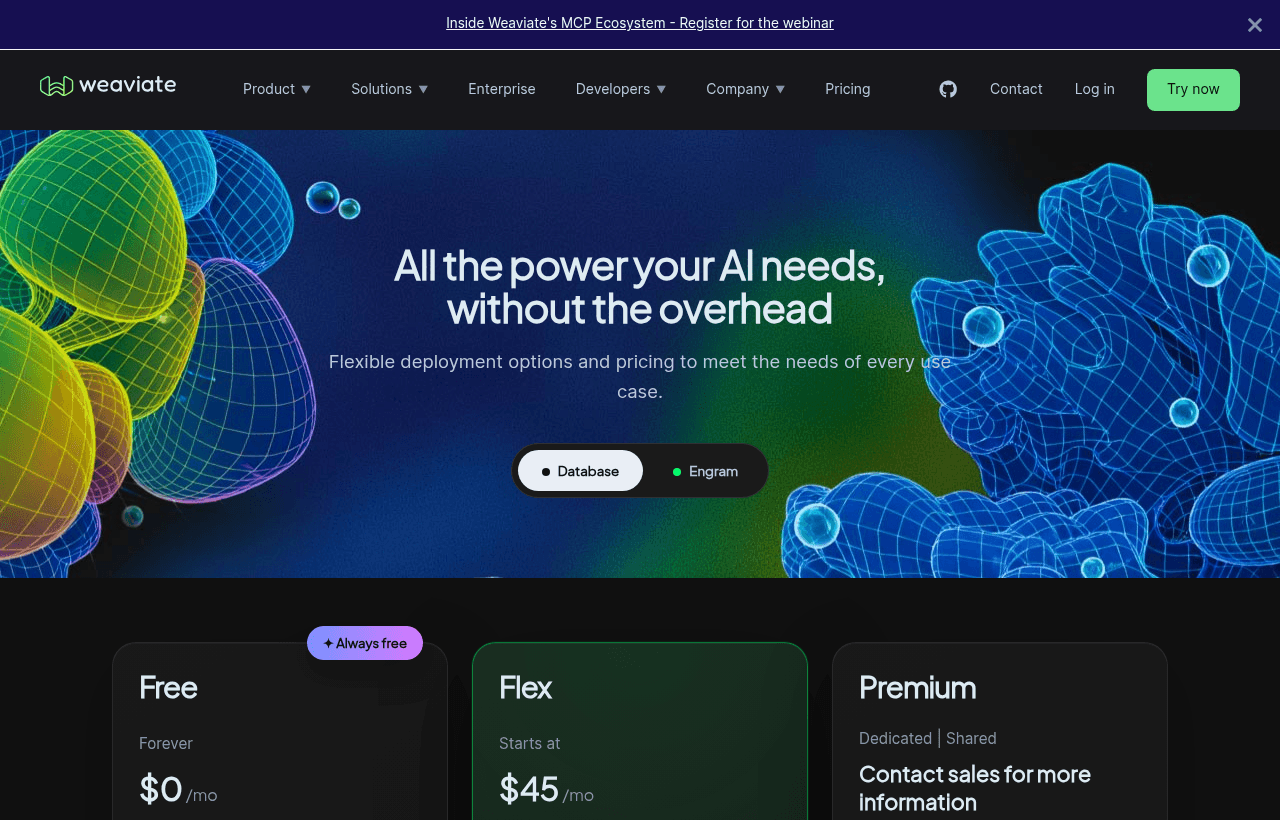
Weaviate's free plan costs $0 and needs no credit card. Each user gets one free cluster. The limits on the pricing page:
- 100,000 objects
- 1 GB memory and 10 GB disk
- 1 collection, with up to 3 tenants
- Weaviate Embeddings: 2,000 requests per day
- Query Agent: 1,000 requests per month
- Basic support, best-effort availability, no backups
Free clusters run on AWS only, in a choice of 2 regions. Weaviate's docs say you can upgrade to a paid plan at any time without losing your data. The create-cluster form sets the optimization profile to Cost Optimized for free clusters.
The one-collection cap is the limit most teams hit first, before the object count. A product that keeps documents, users and conversation memory in separate collections cannot test its real schema on the free plan.
Billing is metered on vector dimensions
Weaviate Cloud does not charge per read or write. It charges for the total number of vector dimensions you store, plus persistent storage and backup storage. Weaviate's explanation is that dimensions are "a simple number you can calculate" instead of abstract read and write units or CPU cycles.
The pricing page lists these starting rates:
| Plan | Minimum | Vector dimensions | Storage | Backup |
|---|---|---|---|---|
| Free | $0 | Free | Free | Free |
| Flex | $45 a month | from $0.00465 per 1M | from $0.12 per GiB | from $0.03036 per GiB |
| Premium Shared | from $400 a month | from $0.003875 per 1M | from $0.10 per GiB | from $0.021 per GiB |
| Premium Dedicated | Contact sales | from $0.002718 per 1M | from $0.33 per GiB | from $0.014 per GiB |
Weaviate's footnote says dimension rates vary by index type, compression method and region. Compression does not change the dimension count, but it lowers memory and compute, so the list price per dimension drops. The pricing calculator offers two profiles. Cost Optimized uses the HFresh index with Auto compression. Performance Optimized uses HNSW with RQ-8 compression. A September 2026 update added RQ-4 compression for HNSW collections at a price between RQ-1 and RQ-8.
The minimum covers the baseline cluster plus dimensions and storage. Backups are billed on top of it. Data transfer is free for a promotional period, and Weaviate says it may add charges later with advance notice.
What $500 buys on Flex
These examples use the starting rates from the table, so they are the low end. Your own rate depends on compression, index type and region, and Weaviate shows it in the Running Costs module in the console. We also assume the rates are monthly, which the page implies but does not state for every line. Vector storage below counts only the raw float32 vectors, 4 bytes per dimension, at 1,536 dimensions per object. Object properties and indexes add more.
200,000 objects: the minimum sets your bill
- Dimensions: 200,000 x 1,536 = 307.2M, at $0.00465 per 1M = $1.43
- Vector storage: 1.14 GiB at $0.12 = $0.14
- Backup: 1.14 GiB at $0.03036 = $0.03
Usage comes to about $1.57, far under the $45 Flex minimum. You pay $45, plus about $0.03 of backup. At about $45.03 a month, $500 lasts 11 months (500 / 45.03 = 11.1).
10 million objects: usage passes the minimum
- Dimensions: 10,000,000 x 1,536 = 15,360M, at $0.00465 per 1M = $71.42
- Vector storage: 57.22 GiB at $0.12 = $6.87
- Backup: 57.22 GiB at $0.03036 = $1.74
Dimensions plus storage come to $78.29, which is above the minimum. Add backup and the total is about $80.03 a month. $500 lasts 6 months (500 / 80.03 = 6.2).
Premium Shared
Premium Shared starts at $400 a month. $500 covers one month and leaves $100. Premium is a prepaid contract, so credits are unlikely to change how you buy it. Ask Weaviate how credits apply to prepaid contracts before you plan around it.
These are list-rate estimates. We could not confirm from Weaviate's pages whether the $500 applies to the minimum, to usage, or to backups.
Flex or Premium: what changes with the tier
| Free | Flex | Premium Shared | Premium Dedicated | |
|---|---|---|---|---|
| Objects | 100,000 | Unlimited | Unlimited | Unlimited |
| Collections | 1 | 1,000 | 1,000 | 1,000 |
| Backup retention | None | 7 days | 30 days | 45 days |
| Availability | Best effort | 99.5% | 99.9% | 99.95% |
| Severity 1 response | None | 1 business day | 4 hours | 1 hour |
| HA and replication | No | Yes | Yes | Yes |
| Clouds | AWS | AWS, GCP | AWS, GCP | AWS, GCP, Azure |
| Regions | 2 | 7 | 7 | About 40 |
| SSO and SAML | No | No | Yes | Yes |
Hybrid search, vector compression, multi-tenancy, RBAC and console metrics are on every plan. Flex adds flexible index types and replication. Premium adds a metrics endpoint, phone and Slack support, and a Technical Account Team as an add-on. HIPAA, AWS PrivateLink and customer-managed volume encryption are Dedicated only, and the pricing page lists HIPAA under Enterprise Cloud on AWS. Bring-your-own identity provider is listed as "coming soon".
What the free cluster leaves out
- Replication and high availability
- Backups
- Any uptime commitment, since availability is "best effort"
- More than one collection
- Flexible index types
- More than 3 tenants
- Phone, Slack or a Severity 1 response time
- Regions beyond 2, and any cloud except AWS
Query Agent and Embeddings are priced separately
Two services run inside Weaviate Cloud and are billed by usage on every plan.
- Weaviate Embeddings. Hosted models, billed per 1M tokens: Snowflake Arctic-Embed-M v1.5 at $0.025, Arctic-Embed-M v2.0 at $0.040, and ModernVBERT ColModernVBERT at $0.065. The free plan allows 2,000 requests a day.
- Query Agent. It turns a plain-language question into database operations. It is free to try at 1,000 requests a month. A monthly plan costs $30 per organization and includes 4,000 requests, with unlimited additional requests billed by usage. Request limits are 30,000 a month on Flex.
If you embed with a third-party model such as OpenAI or Cohere, Weaviate's docs describe vectorizer and generative modules for providers including those two. You pay the provider directly.
Hybrid search blends keywords and vectors with one dial
Hybrid search runs a keyword search and a vector search together and fuses the two result lists. The alpha parameter sets the balance: 1 is pure vector search and 0 is pure keyword search. Relative Score Fusion has been the default fusion method since v1.24, and you can switch to ranked fusion. Relative Score Fusion is also the method to use if you want autocut on hybrid queries.
For a product search or a docs assistant, Exact product codes and error strings favor keywords. Vague questions favor vectors. Start at alpha 0.5 and test with your own queries.
Multi-tenancy gives each customer a shard
Turn multi-tenancy on in the collection definition. Each tenant then gets its own shard, so one customer's data stays separate from another's. A tenant can be ACTIVE, INACTIVE (kept on disk) or OFFLOADED (moved to cloud storage). Setting autoTenantCreation to true makes Weaviate create a tenant when you first write to it, instead of returning an error. Tenant statuses were renamed from HOT and COLD in v1.26.
This matters for SaaS products with many small customers, where most tenants are idle most of the time. Deactivating idle tenants keeps memory free for the active ones. On the free plan you get 3 tenants, enough to test the pattern and nothing more.
Open source, with one licensing detail
The main repository has about 16,900 GitHub stars. Code outside the wl directory is under BSD-3-Clause. Code inside it falls under the Weaviate License, and Weaviate's docs describe an enterprise edition that needs a license key. GitHub's license detector shows "NOASSERTION" for that reason. If you plan to self-host, read the license file for the features you need.
You can run the engine yourself with Docker or Kubernetes at no license fee for the BSD parts, and take on upgrades, backups and scaling. Weaviate Cloud wraps the same project in a managed service and adds the Embeddings service, Query Agent and data import.
Security the vendor publishes
Weaviate Cloud is SOC 2 Type II, audited through Drata, with a public Trust Portal. HIPAA compliance is available on Enterprise Cloud on AWS. Every plan includes RBAC. Weaviate's cloud docs also include a notice that the GraphQL API is deprecated and will be switched off on Weaviate Cloud on May 1, 2027. New clusters already have GraphQL off, and clusters that have not used it in 30 days lose it from December 1, 2026. If you are starting now, use the newer client libraries and not GraphQL.
Weaviate, Pinecone, Qdrant side by side
| Weaviate | Pinecone | Qdrant | |
|---|---|---|---|
| Free tier | 100,000 objects, 1 GB memory, 10 GB disk, 1 collection | Starter: up to 2 GB storage, 2M write units, 1M read units a month | 1 node, 0.5 vCPU, 1 GB RAM, 4 GB disk |
| First paid step | Flex, $45 a month minimum | Builder $20 a month flat; Standard $50 a month minimum | Usage based, hourly; no fixed monthly price on the page |
| Billing unit | Vector dimensions, storage, backup | Write units, read units, storage | vCPU, memory, disk reserved by the hour |
| Open-source engine | Yes, BSD-3-Clause outside the wl folder | No | Yes, Apache 2.0 |
| Startup offer | Discounted rate through a program or VC; our listing says $500 in credits | Startup program, credits not quantified | 20% off the first year, by application |
Weaviate's Flex minimum is $45, above Pinecone Builder at $20, so Weaviate is not the lowest entry price in this table. What Weaviate adds is hybrid search and multi-tenancy on every plan, including free. Qdrant's 20% program has published rules, while Weaviate's page lists no amount.
Who Weaviate is for
- AI startups building RAG or semantic search who want keyword and vector search in one query
- SaaS teams with many small customers who need per-tenant isolation
- Teams that want a managed service now and a self-hosted option later
- Founders in a program such as Y Combinator or Techstars, which is the audience Weaviate's startup page names
When Weaviate is the wrong pick
- Anyone who needs more than one collection on a free plan. Free allows one.
- Teams that want a single flat bill. Weaviate meters dimensions, storage and backups.
- Projects under 100,000 objects that fit the free cluster. You do not need credits yet.
- Teams who need uptime guarantees at no cost. Free is best effort.
Tips for your first weeks on Weaviate
- Pick the optimization profile deliberately. Cost Optimized and Performance Optimized price differently in the calculator.
- Check the Running Costs module in the console before loading data, because rates depend on compression and region.
- Plan for one collection on free. Store different document types in one collection with a type property while you prototype.
- Turn on multi-tenancy at collection creation. You set it in the collection definition.
- Test hybrid search at several alpha values with real questions.
- Remember that backups are on by default for every cluster and bill on top of the minimum.
How to get the Weaviate offer
- Click through the SaaSOffers link on this page to weaviate.io/startup-deal.
- Create or log in to the Weaviate Console with the email you want the deal applied to.
- Complete your organization details in your account settings.
- Submit the redemption form with the same email as your Console account. It asks for your company name and your program or VC, and optional proof if requested.
- Weaviate validates the request and applies the deal to your account.
- Confirm the credit amount with Weaviate when it is applied. Our listing says $500.
There is no promo code. If your Console email differs from the email on your program account, tell Weaviate in the message field.
Who Is This Deal For?
Early-Stage Startups
Seed and pre-seed companies looking to move fast without overspending on tools.
Growing SaaS Teams
Series A+ companies scaling their stack and optimizing software costs.
Solo Founders
Indie hackers and bootstrapped founders who need enterprise tools at startup prices.
Get $500 in credits off Weaviate
Premium deal. Upgrade once, unlock everything.
!Eligibility Requirements
AI startup building search or RAG
Frequently Asked Questions
Everything you need to know about this startup deal.
Get the weekly deals digest
New verified startup deals every week. No spam, ever. Unsubscribe anytime.
Related Offers

Replicate
Used by 1,772 members
$500 in credits
Run open-source ML models in the cloud, deploy Llama, Stable Diffusion, and custom models via API without GPU management.
View offer
Consensus
Used by 1,544 members
Free Plan
AI-powered research platform that finds, summarizes, and synthesizes scientific papers.
View offer
Laxis
Used by 2,176 members
Free Plan
AI meeting assistant that records, transcribes, and generates actionable meeting notes.
View offer
ZoomInfo
Used by 2,014 members
Free Trial
B2B data platform for sales and marketing intelligence with contact databases.
View offerDeal Summary
Looking for more startup deals?
Browse all offers