
Doppler Promo Code: 1 year free Growth
Secret management platform that syncs environment variables across development, staging, and production.
Premium: $79/year for unlimited deals
Already have an account? Log in
Deal Highlights
What Doppler Gives a Startup
Doppler is a secret management platform that syncs environment variables and secrets across development, staging, and production. This deal gives a startup one year free on the Growth plan, which means a team can run proper secrets infrastructure for its first year without paying for it. For an engineering team that is currently juggling secrets in .env files, shared password managers, and copy-pasted Slack messages, that is a meaningful upgrade with no cost attached during the period when budgets are tightest.
Every application depends on secrets. API keys, database URLs, third-party tokens, signing keys, and connection strings all have to reach the code that needs them, and all of them are dangerous if they leak. Most startups start by scattering these values across local files and cloud dashboards, and that approach quietly becomes a liability as the team and the number of environments grow. Doppler centralizes secrets into one source of truth and syncs them out to wherever they are needed, which replaces a fragile manual habit with real infrastructure.
The requirement for this deal is simply an engineering team managing secrets, which is to say any team shipping software. The Growth plan tier adds the access controls, environments, and integrations that a growing team needs, and getting it free for a year lets a startup adopt good practices early instead of retrofitting them after an incident.
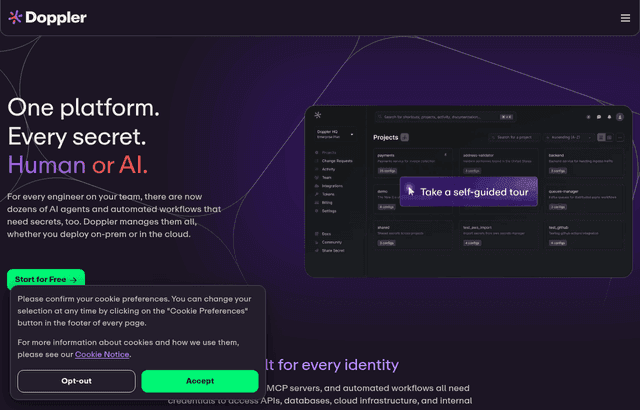
Doppler, one of the tools included in this startup deal.
One Source of Truth for Every Secret
The core idea behind Doppler is centralization. Instead of secrets living in a dozen places, they live in Doppler, organized by project and by environment. Development, staging, and production each get their own set of values, and the same variable name maps to the right secret in each place. When a value changes, it changes in one location and propagates from there.
For a startup, this solves a problem that gets worse silently. When secrets live in local files, every developer has a slightly different copy, and nobody is sure which one is current. New hires spend their first day hunting for the right values. When a key needs to be rotated, someone has to find every place it was copied and update each one by hand, and inevitably one gets missed. Centralizing in Doppler removes that drift. There is one canonical set of secrets, and everything else reads from it.
The reason this matters is reliability. Configuration mistakes are a common cause of outages and bugs, and many of them come down to an environment running with a stale or wrong secret. A single source of truth makes those mistakes far less likely, because there is no longer a pile of divergent copies to get out of sync.
Syncing Across Development, Staging, and Production
Doppler does not just store secrets, it delivers them. It syncs values into the environments and tools where they are actually used, whether that is a developer's local machine, a CI pipeline, a container platform, or a production host. The team defines the secrets once, and Doppler makes sure each environment gets the right set.
This is where the platform earns its place for a startup. The gap between environments is a frequent source of the classic "works on my machine" failure. Code runs fine locally and breaks in production because a variable was set in one place and forgotten in another. By treating each environment as a first-class configuration that Doppler keeps in sync, the team removes a whole category of environment mismatch bugs. Promoting a change from staging to production stops being an exercise in remembering which variables to update.
For a small team, the practical payoff is fewer late-night debugging sessions that turn out to be a missing environment variable. The infrastructure enforces consistency so the humans do not have to.
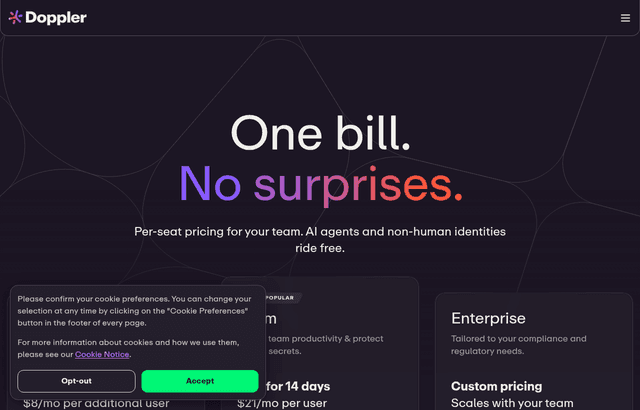
A look at Doppler before the discount, so you can see what the deal saves you.
Access Control and Keeping Secrets Out of Code
The most dangerous place a secret can end up is committed to a git repository, where it is visible to everyone with access and lives forever in the history even after it is deleted. Doppler exists partly to make that mistake unnecessary. Because secrets are injected at runtime from Doppler rather than written into files that get committed, there is far less reason for a key to ever touch the codebase.
The Growth plan adds access controls that let a team decide who can see and change which secrets. Not every engineer needs production database credentials, and not every contractor needs access to payment keys. Being able to scope access means the blast radius of a compromised account or a departing employee is smaller. For a startup that is starting to think about security seriously, perhaps because a customer asked about it or a compliance process is looming, having real access control over secrets is a concrete, demonstrable improvement.
This matters more as the team grows. With three engineers, informal trust works. With fifteen, and with contractors and multiple environments, informal trust is a risk. Adopting Doppler early means the controls are already in place when the team reaches the size where they become necessary.
Integrations That Fit an Existing Stack
Doppler is designed to plug into the tools a startup already uses rather than forcing a rebuild. It integrates with common hosting platforms, container orchestrators, CI systems, and cloud providers, injecting secrets into each without custom glue code. The team keeps its existing deployment setup and simply points it at Doppler for configuration.
For a startup, low switching cost is what makes adoption realistic. An engineering team rarely has time for a big migration project, so a tool that slots into the current workflow gets adopted while one that demands a rewrite gets shelved. Doppler's integrations mean a team can move its secrets in incrementally, one project or one environment at a time, without a risky big-bang cutover.
The value grows as the stack does. When a startup adds a new service, a new environment, or a new hosting provider, Doppler's integrations mean the secrets follow along without a fresh round of manual configuration. The platform becomes the stable configuration layer underneath a changing infrastructure.
Rotation, Auditing, and Responding to Incidents
Secrets do not stay valid forever. Keys get rotated on a schedule, revoked when a vendor relationship ends, or changed urgently when there is a suspected leak. In a manual setup, rotation is dreaded because it means finding every copy of a secret and updating it, with a real chance of breaking something or missing a spot. With Doppler, rotation happens in one place and propagates automatically, which turns a scary operation into a routine one.
Doppler also gives visibility into secret access and changes, so a team can see what changed and when. If there is an incident, being able to answer "what had access, and what was changed" quickly is the difference between a contained response and a scramble. For a startup that has never had to run a security incident, having this history already captured means the answers exist when they are suddenly needed.
The ability to rotate confidently changes behavior. Teams that fear rotation put it off, which means compromised or overexposed keys linger longer than they should. Teams that can rotate in one click do it more often, which is exactly the healthier habit. Doppler lowers the cost of doing the safe thing, so the safe thing actually gets done.
Doppler Compared to .env Files and Manual Approaches
Compared to .env files, Doppler is the difference between a habit and a system. Environment files are quick to start with and cost nothing, which is why almost every project begins there. But they do not sync, they do not enforce access control, they drift between developers, and they have a nasty tendency to get committed by accident. They work until the team grows past the point where informal coordination holds, and then they become a source of outages and leaks.
Compared to storing secrets in a general password manager or a cloud provider's basic secret store, Doppler is purpose-built for the developer workflow. A password manager is made for humans logging into services, not for injecting configuration into a deployment pipeline. A cloud provider's secret store ties you to that provider and often lacks the cross-environment syncing and developer ergonomics that Doppler provides. Doppler sits at the layer that a multi-environment engineering team actually works in, and it stays consistent even if the underlying cloud changes.
The comparison comes down to when a team adopts real secret management. Almost everyone gets there eventually, usually after a scare. Doing it early, with a year of the Growth plan free, means a startup builds the habit before the incident rather than after it.
Making the Year of Free Growth Count
The best way to use a free year of the Growth plan is to migrate off the fragile setup completely rather than running Doppler alongside the old habits. Move the secrets for every project and every environment into Doppler, wire up the integrations to the hosting and CI systems, and delete the scattered .env files and shared documents that used to hold these values. The goal by the end of the free year is that Doppler is simply how the team does secrets, not an experiment running in parallel.
A sensible order of operations is to start with one project, get its development, staging, and production environments syncing cleanly, then use that as the template for the rest. Set up the access controls while the team is small enough that the mapping is obvious. Establish a rotation routine so that using the Growth plan's capabilities becomes a habit rather than a feature nobody touches.
Because the offer runs for a full year, there is time to reach real maturity: every secret centralized, every environment consistent, access scoped appropriately, and rotation routine. A team that gets there will find that when the free year ends, Doppler has become infrastructure it does not want to give up, which is the point.
How Doppler Supports the Team as It Grows
Doppler fits a startup because the problem it solves gets harder as the company scales, and the platform is built for that trajectory. With a couple of engineers and one environment, secrets are annoying but manageable by hand. With a larger team, multiple services, several environments, and outside contributors, manual secret management stops being viable and starts causing real incidents. A team that adopted Doppler early crosses that threshold without a crisis, because the infrastructure was already in place.
The centralization, syncing, access control, and rotation that Doppler provides all become more valuable with scale. More engineers means access control matters more. More services means centralization matters more. More environments means syncing matters more. The platform a startup adopts as a small team is the same platform that serves it as a larger one, which avoids the disruptive re-platforming that comes from outgrowing a stopgap.
Getting Started With Doppler
Adoption is easiest when a team treats the first project as a template. Create a project in Doppler, define its development, staging, and production environments, and move the secrets for that one service in. Wire the local development workflow to pull from Doppler so engineers stop keeping their own .env copies, then connect the CI pipeline and the hosting platform so staging and production read from the same source. Once one project runs cleanly this way, the pattern repeats for the rest with little thought, because the team already knows the shape of the setup. Setting access controls and a rotation routine while the first project is fresh means those habits are established before the number of secrets grows large enough to make them urgent.
Who Should Claim This Deal
This deal is for any engineering team that ships software and manages secrets, which is nearly all of them. It is a particularly strong fit for a startup that is still using .env files and shared documents and knows, somewhere in the back of its mind, that the approach will not hold. Adopting Doppler on a free year of the Growth plan lets that team fix the problem before it becomes an incident, at no cost during the runway-sensitive early stage.
It fits teams that run multiple environments and are tired of environment mismatch bugs, teams that are starting to care about security and access control, and teams preparing for a compliance process where demonstrable secret management will be expected. If a startup handles API keys, database credentials, and third-party tokens and wants them centralized, synced, and controlled rather than scattered and fragile, this is the deal to claim. Move the secrets in, wire up the integrations, and let the free year turn good practice into permanent infrastructure.
Who Is This Deal For?
Early-Stage Startups
Seed and pre-seed companies looking to move fast without overspending on tools.
Growing SaaS Teams
Series A+ companies scaling their stack and optimizing software costs.
Solo Founders
Indie hackers and bootstrapped founders who need enterprise tools at startup prices.
Get 1 year free Growth off Doppler
Premium deal. Upgrade once, unlock everything.
!Eligibility Requirements
Engineering team managing secrets
Frequently Asked Questions
Everything you need to know about this startup deal.
Doppler's free Community plan supports 5 users and unlimited secrets. The Growth plan ($18/user/month) adds advanced access controls, audit logs, and integrations. The 1-year deal saves $216/user.
Get the weekly deals digest
New verified startup deals every week. No spam, ever. Unsubscribe anytime.
Related Offers

Toggl Track
Used by 1,100 members
Free Plan
Simple and intuitive time tracking for teams with reporting and integrations.
View offer
Auth0
Used by 994 members
1 year of B2B Professional free
Get 1 year of the Auth0 B2B Professional plan free, with up to 100,000 monthly active users, SSO, enterprise MFA and SCIM.
View offer
Bugsnag
Used by 471 members
Free Plan
Error monitoring and stability management for web and mobile applications.
View offer
Turborepo
Used by 1,880 members
Free & Open Source
High-performance build system for JavaScript and TypeScript monorepos by Vercel.
View offer
Windmill
Used by 1,501 members
Free Plan
Open-source developer platform for building internal tools, workflows, and scripts.
View offer
Height
Used by 1,442 members
Free Plan
AI-powered project management tool with autonomous task management and workflows.
View offerDeal Summary
Looking for more startup deals?
Browse all offers