
Customer.io Startup Credits: $1,000 in credits
Send targeted emails, push notifications, and in-app messages based on real user behavior. The messaging platform for product teams.
Free · Opens in new tab
Already have an account? Log in
Deal Highlights
What Customer.io Gives a Startup
Customer.io is a messaging platform for product teams. It sends targeted emails, push notifications, and in-app messages based on what users actually do inside a product, not on a fixed schedule or a static list. The offer is $1,000 in credits for an early-stage startup opening a new account, which gives a young company real room to build behavior-driven messaging and see it work before any spend starts.
Most startups begin by sending the same message to everyone. A newsletter to the whole list, a welcome email to every new sign-up, a launch announcement blasted out at once. That works for a while, but it ignores the thing that makes messaging actually effective: relevance. A message that lands because it responds to what a person just did, or did not do, is worth far more than a generic broadcast. Customer.io is built around that idea. It watches user behavior and triggers messages based on it, so the right person gets the right message at the right moment. For a startup trying to turn sign-ups into engaged users and engaged users into customers, that shift from broadcasting to responding is where growth comes from.
This article covers what Customer.io does, why each capability matters to an early-stage team, how it compares to a basic email tool, and how to get the most out of the $1,000 in credits.
Customer.io, one of the tools included in this startup deal.
Messaging Driven by Real Behavior
The core of Customer.io is behavior-based messaging. Instead of sending on a schedule, the team defines messages that trigger when a user does something, or fails to do something, in the product. A user signs up but never completes onboarding. A user tries a feature once and never comes back. A user hits a usage milestone. Each of these behaviors can trigger a message tailored to that exact moment.
This matters because relevance drives results. A generic email to everyone gets ignored because most of it does not apply to most people. A message that responds to what a specific user just did feels like the product paying attention. The onboarding nudge that arrives right when a user stalls, the tip that shows up when someone discovers a feature, the check-in when a user goes quiet. These land because they are timely and personal, and timely, personal messages get opened, read, and acted on.
For a startup, behavior-based messaging is how a small team punches above its weight. Instead of a marketer manually deciding who to email and when, the messaging responds automatically to what every user is doing, at a scale no person could manage by hand. The product itself, through its data, decides who needs to hear what.
Emails, Push, and In-App Messages Together
Customer.io is not just email. It sends push notifications and in-app messages too, all driven by the same behavioral data and coordinated through the same platform. This matters because different messages belong in different places. A re-engagement message might work best as a push notification to someone who has not opened the app in a week. A feature tip might work best as an in-app message shown while the user is actually using the product. A receipt or a summary might belong in email.
For a startup, having these channels in one platform means the team can reach users wherever they are, without stitching together separate tools that do not share data. The messaging strategy stays coherent because it all runs on the same understanding of the user. A person's behavior informs their email, their push, and their in-app experience together, rather than three disconnected systems each guessing independently.
This coordination also prevents the kind of clumsy over-messaging that annoys users. When everything runs through one platform, the team can reason about a user's whole messaging experience and avoid hitting them with the same thing across three channels. For a young product still building trust, messaging that feels considered rather than spammy protects the relationship with the user.
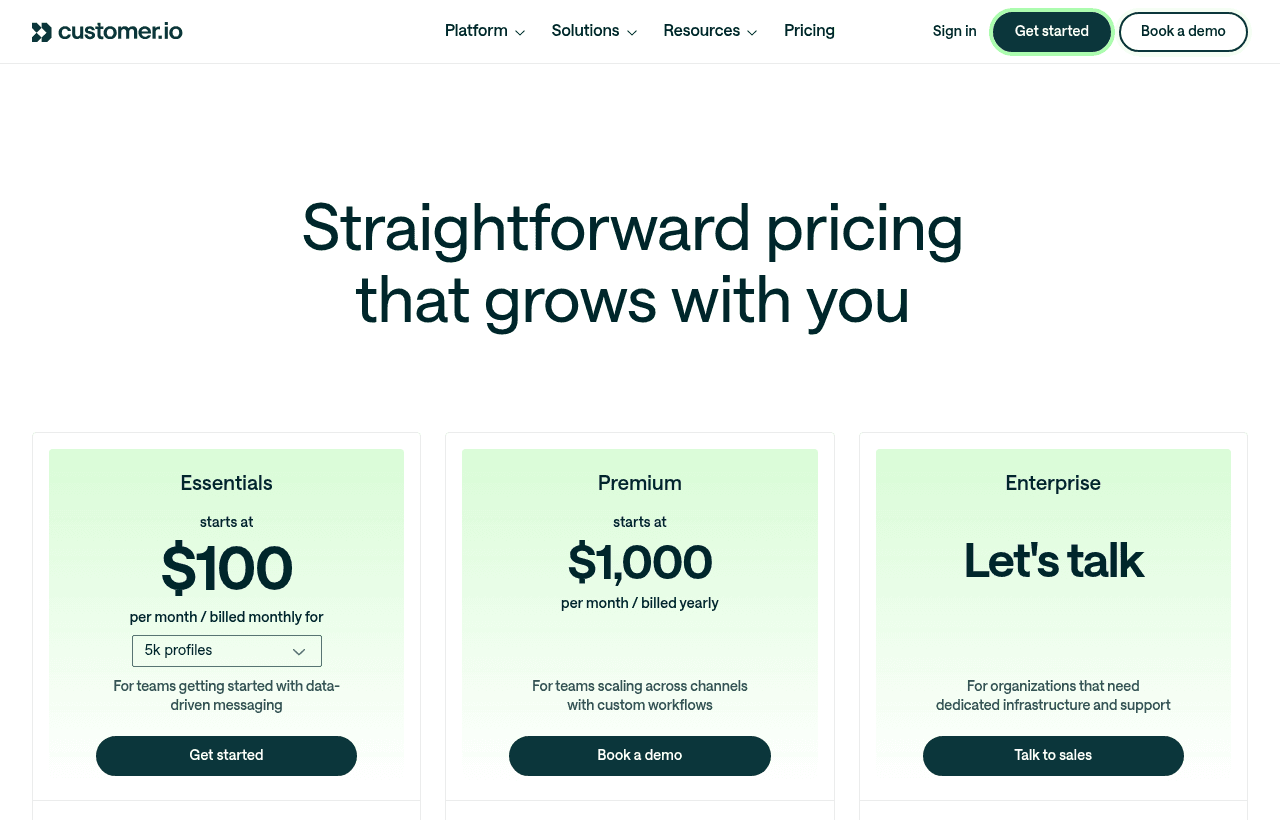
A look at Customer.io before the discount, so you can see what the deal saves you.
Segmentation That Reflects the Product
Customer.io lets a team build segments based on user attributes and behavior. Users who signed up this week and have not activated. Users on a trial that ends in three days. Users who hit a certain usage threshold. Power users who might be ready to upgrade. These segments update automatically as user behavior changes, so a user moves in and out of a segment as their relationship with the product evolves.
For a startup, this dynamic segmentation is what makes targeted messaging possible at scale. Instead of manually maintaining lists that are stale the moment they are made, the team defines the criteria once and Customer.io keeps the segments current. A message aimed at trial users who have not activated always reaches exactly the right people, because the segment recalculates as users activate or their trials end.
Good segmentation also sharpens the whole messaging strategy. Thinking in terms of behavioral segments forces a team to ask what different groups of users actually need, which leads to better messages. The trial user about to churn needs something different from the power user ready to upgrade, and segmentation makes it natural to treat them differently.
Automated Journeys and Lifecycle Messaging
Customer.io lets a team build automated messaging journeys, sequences of messages that guide a user through their lifecycle with the product. A new user enters an onboarding journey that walks them toward activation. A user who goes quiet enters a re-engagement journey. A trial user enters a conversion journey as their trial winds down. These flows run automatically, branching based on what the user does at each step.
For a startup, these journeys are how the product nurtures relationships without a person having to manage each one. The onboarding sequence that helps a new user reach their first success, running automatically for every new sign-up, is worth more than any one-off email because it works continuously and scales infinitely. Every user gets the guidance they need at the moment they need it, without anyone lifting a finger after the journey is built.
The branching logic is what makes these journeys smart rather than rigid. A user who completes an onboarding step early skips ahead. A user who stalls gets an extra nudge. The journey adapts to each user's actual path through the product, which makes it feel like guidance rather than a scripted drip. For a team trying to improve activation and retention, well-built lifecycle journeys are one of the highest-leverage things Customer.io makes possible.
Built for Product Teams
Customer.io describes itself as the messaging platform for product teams, and that framing matters. It is designed to work off product data, the events and attributes that describe what users do, rather than off a marketing list divorced from the product. This means the messaging is grounded in the same data the product runs on, which makes it far more powerful than a marketing tool that only knows email addresses and open rates.
For a startup where the line between product and marketing is blurry, this fit is natural. The people building the product and the people trying to grow it are often the same small group, and Customer.io speaks their language. It connects to the product's data, triggers on the product's events, and lets the team reason about users in product terms rather than marketing abstractions. That alignment makes the whole messaging effort more coherent and more effective.
Customer.io Compared to a Basic Email Tool
Most startups start with a simple email tool, the kind built for newsletters and broadcasts. Those tools are good at what they do: collect a list, design an email, send it to everyone or to a manually chosen segment. For a company that just wants to send an occasional announcement, that is enough.
The limits show up as soon as a team wants messaging that responds to behavior. A basic email tool does not know what users do in the product. It cannot trigger a message when a user stalls in onboarding, because it has no idea onboarding exists. It sends to lists, not to behaviors. It does email and nothing else. Growing beyond broadcasts means either heavy manual work or a different tool entirely.
Customer.io is that different tool. It is built from the ground up around product behavior, multiple channels, dynamic segments, and automated journeys. Where a basic email tool sees a list of addresses, Customer.io sees users doing things and responds accordingly. For a startup serious about using messaging to drive activation, retention, and conversion, that difference is the difference between a megaphone and a conversation. The credits let the team build that conversation without an upfront bill.
Making the $1,000 in Credits Count
The $1,000 in credits gives an early-stage startup meaningful room to build and run behavior-driven messaging. A few moves make the credits go further.
Start with the messaging that has the highest impact on the business: activation and onboarding. The single most valuable journey most startups can build is one that guides new users to their first real success in the product, because activation is what turns a sign-up into a user who sticks. Build that journey first, wire it to the product's onboarding events, and let it run for every new user. This is where behavior-based messaging pays off fastest.
Next, set up the product events and user attributes that messaging depends on. Customer.io is only as smart as the data it receives, so investing early in sending the right events, the actions that signal activation, engagement, and churn risk, is what unlocks everything else. Getting the data foundation right during the credit period means the messaging keeps getting better as the team builds on it.
Then, use the credits to actually test and iterate. Try different onboarding sequences, different re-engagement timing, different messages, and watch what moves the numbers. The credits are runway to learn what works for this specific product and audience, which is knowledge that keeps paying off long after the credits are spent. A startup that ends the credit period knowing which messages drive activation has gained something more valuable than the credits themselves.
How Customer.io Scales With the Product
The messaging foundation a startup builds during the credit period scales directly as the product grows. The onboarding journey that guided the first hundred users guides the hundred-thousandth just as well, because it runs off behavior, not manual effort. Adding new messages, new segments, and new journeys extends the same system rather than replacing it.
As the team grows, the platform grows with it. More sophisticated segmentation, more branching journeys, tighter integration with product data. The investment made early, in clean events and well-built core journeys, compounds. A startup that establishes good messaging practices while small carries those practices into every stage of growth, which is far easier than trying to bolt behavior-driven messaging onto a large product that never had it.
Common Messaging Wins for a Startup
A few messaging patterns deliver outsized value for early-stage teams, and Customer.io handles all of them. Onboarding sequences that walk a new user to their first success and lift activation. Re-engagement flows that reach a user who has gone quiet before they churn for good. Trial-conversion journeys that nudge a trial user toward upgrading as their trial nears its end. Milestone messages that celebrate when a user hits a meaningful point in the product, deepening their attachment. Feature-adoption prompts that surface a relevant feature to a user who has not discovered it yet. Each of these is behavior-driven, each fits naturally into Customer.io's model, and each targets a specific point in the user journey where a well-timed message changes the outcome. A startup that runs even a handful of these well will see the effect in its activation and retention numbers.
Who Should Claim This Deal
This deal is aimed at an early-stage startup opening a new Customer.io account, which is exactly what the requirements specify. If the team is past its first sign-ups and wants to turn those sign-ups into activated, engaged, retained users through smart messaging, Customer.io is built for that job.
It is an especially strong fit for a product-led company where growth depends on getting users to activate and stick, rather than on one-off broadcasts. The behavior-driven model, the multiple channels, and the automated journeys are exactly what such a company needs. The $1,000 in credits gives the team real room to build that messaging, ground it in product data, and learn what drives growth before any spend begins. For an early-stage startup ready to message users based on what they actually do, this is a deal worth claiming.
Who Is This Deal For?
Early-Stage Startups
Seed and pre-seed companies looking to move fast without overspending on tools.
Growing SaaS Teams
Series A+ companies scaling their stack and optimizing software costs.
Solo Founders
Indie hackers and bootstrapped founders who need enterprise tools at startup prices.
Get $1,000 in credits off Customer.io
Premium deal. Upgrade once, unlock everything.
!Eligibility Requirements
Early-stage startup, new Customer.io account
Frequently Asked Questions
Everything you need to know about this startup deal.
Customer.io sends messages triggered by user behavior (events in your product). Mailchimp sends messages to email lists on schedules. Customer.io is better for SaaS lifecycle messaging. Mailchimp is better for newsletters and broadcast marketing. They serve different use cases.
Get the weekly deals digest
New verified startup deals every week. No spam, ever. Unsubscribe anytime.
Related Offers

Drip
Used by 1,080 members
Free Trial
Email marketing automation platform built for e-commerce and direct-to-consumer brands.
View offer
SurveyMonkey
Free plan
Free SurveyMonkey Basic plan: unlimited surveys, 10 questions per survey and AI survey building. Upgrade only when you need more responses.
View offer
Tally
Used by 908 members
Free forever
Free form builder, unlimited forms, responses, and features with no paywall. The anti-Typeform.
View offer
Klaviyo
Used by 3,980 members
Free Plan
Get the Klaviyo Free Plan, the email and SMS marketing platform that powers most of the top Shopify stores, with deep ecommerce data, predictive analytics, and pre-built revenue flows.
View offer
SpyFu
Used by 458 members
Free Trial
Competitive intelligence tool for SEO and PPC, analyze competitor keywords and ads.
View offer
Sprout Social
Used by 947 members
Free Trial
Enterprise social media management platform with analytics and engagement tools.
View offerDeal Summary
Looking for more startup deals?
Browse all offers